

Anthony Davis at 32: Can He Still Be a Top-10 Player?
Based on 30+ years of data and historical comps, the odds are against AD — though his unique profile and a few key comparisons leave room for optimism.

Last September, I wrote what I thought was the biggest big-picture question for the Dallas Mavericks and their chances of staying a contender after that surprising trip to the Finals. In an article titled The Kyrie Irving Timeline, I dug into how many peak Irving years we could realistically expect based on his age, injury history, and historical comps. At the time, there was reason for optimism.
We know how much has changed since. Luka Dončić was traded. Irving will miss most of the upcoming season because of the devastating ACL injury. The Mavericks won the lottery and the Cooper Flagg sweepstakes, getting their hands on one of the best rookie prodigies in recent history — making the long-term future far brighter than it looked in April, when the wounded Mavs fell to the Memphis Grizzlies in the Play-In and failed to make the playoffs.
But in the short term, for this season, the key question feels awfully close to the one I asked last September: can an injury-prone 32-year-old superstar still perform at a peak level for at least another year?
Only this time it’s not about Irving. It’s about Anthony Davis.
As always when I do these historical deep-dives, thanks to my friend and injury chronicler Jeff Stotts, founder of InStreetClothes.com, for his input and help with historical injury data.
Today’s highlights:
Anthony Davis —a top 10 player if healthy?
All-NBA Team selections: a young man’s award 📊
Do big men peak earlier? A short and exclusive list 📊
Injury history of big men who made All-NBA or All-Defense past age 32 📊
Reason for cautious optimism and the intriguing case of Marcus Camby 📊
1-Anthony Davis —a top 10 player if healthy?
“If Davis strings together a healthy season, he’s automatically Top 10.”
“This is a top 10 player, objectively and one of the best two-way players when he's healthy.”
Those are just two of the lines that stuck with me from Mavs-centric podcasts this summer when the conversation turned to Anthony Davis. And it’s not like these takes are far-fetched. Just a season ago, Davis was undeniably that: averaging 24.7 points, 12.6 rebounds, and 2.3 blocks per game, while finishing fourth in Defensive Player of the Year voting, earning an All-NBA Second Team spot, a First Team All-Defense nod, and yet another All-Star selection.
The key, of course, with Davis is always the if/when healthy part.
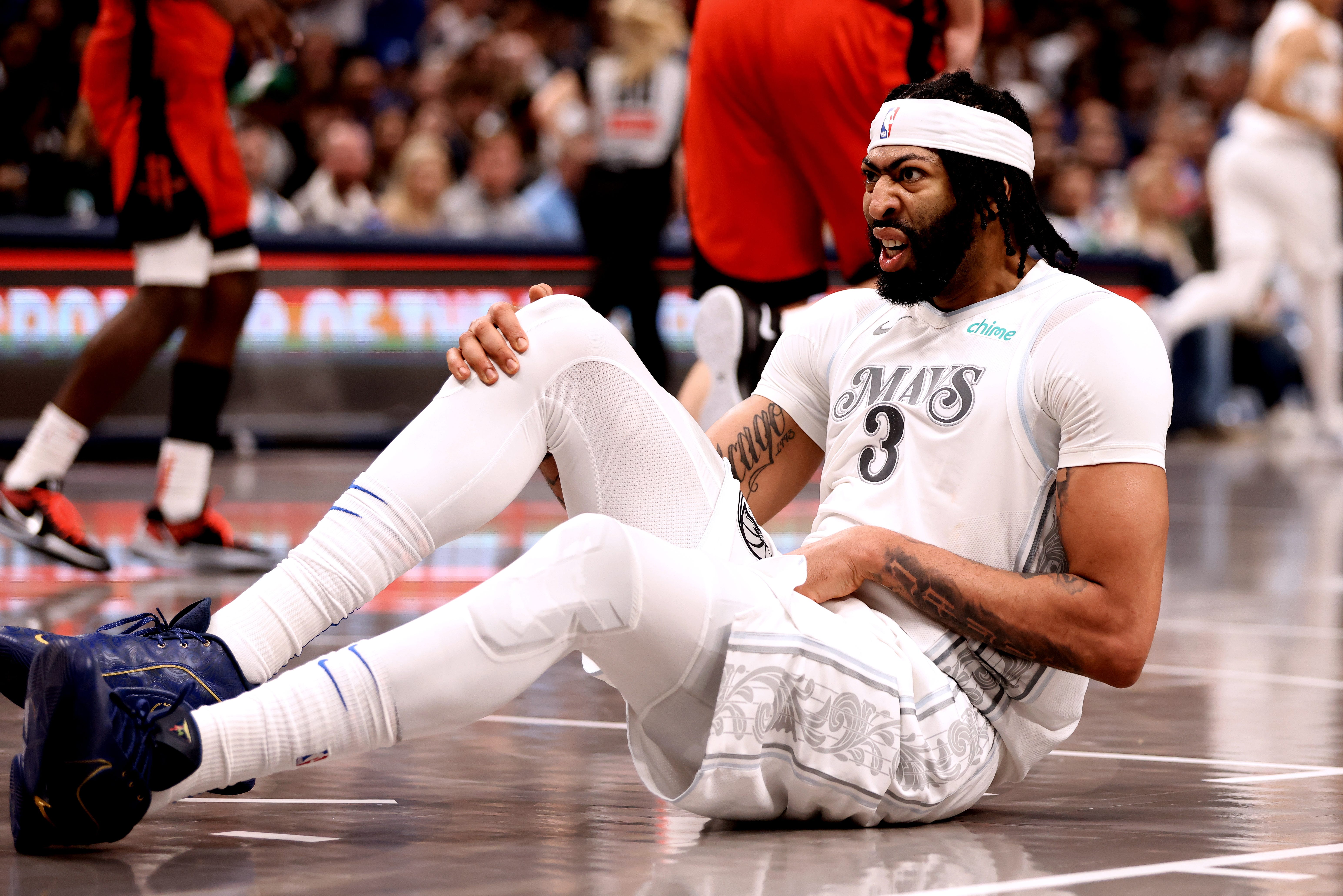
After that outstanding season he kept playing at a top-10 level, starting the 2024-25 campaign on fire with the Lakers. But it turned into another injury-plagued year (a chronological overview of AD’s injury history is here, with detailed data breakdown from me in the following sections): a bruised heel, abdominal and adductor strains piled up, forcing him to miss 31 games and limiting him to just nine appearances as a Maverick. AD's recent health problems didn’t end there. Later in the summer it was reported that he underwent a procedure to repair a detached retina suffered during last season, another injury scare for Mavericks fans and one that kept him out of 5-on-5 action until just a couple of days ago.
2-All-NBA Team selections: a young man’s award 📊
Circling back to my initial question about Davis’s remaining peak years, the real question for me is this: even if healthy, is he guaranteed a Top 10 spot as he enters his age 32-33 season and turns 33 in March?
To see what kind of historical precedent exists, I started my research by parsing All-NBA Team selections, spanning more than 30 years and going back to 1994. Earning a spot on one of the All-NBA teams is a good signal that a player is in that top 10–15 conversation.
My first takeaway from the data is that All-NBA Team selection really is a young man’s award. The average age of a player making one of the three teams is just 27.5 years.
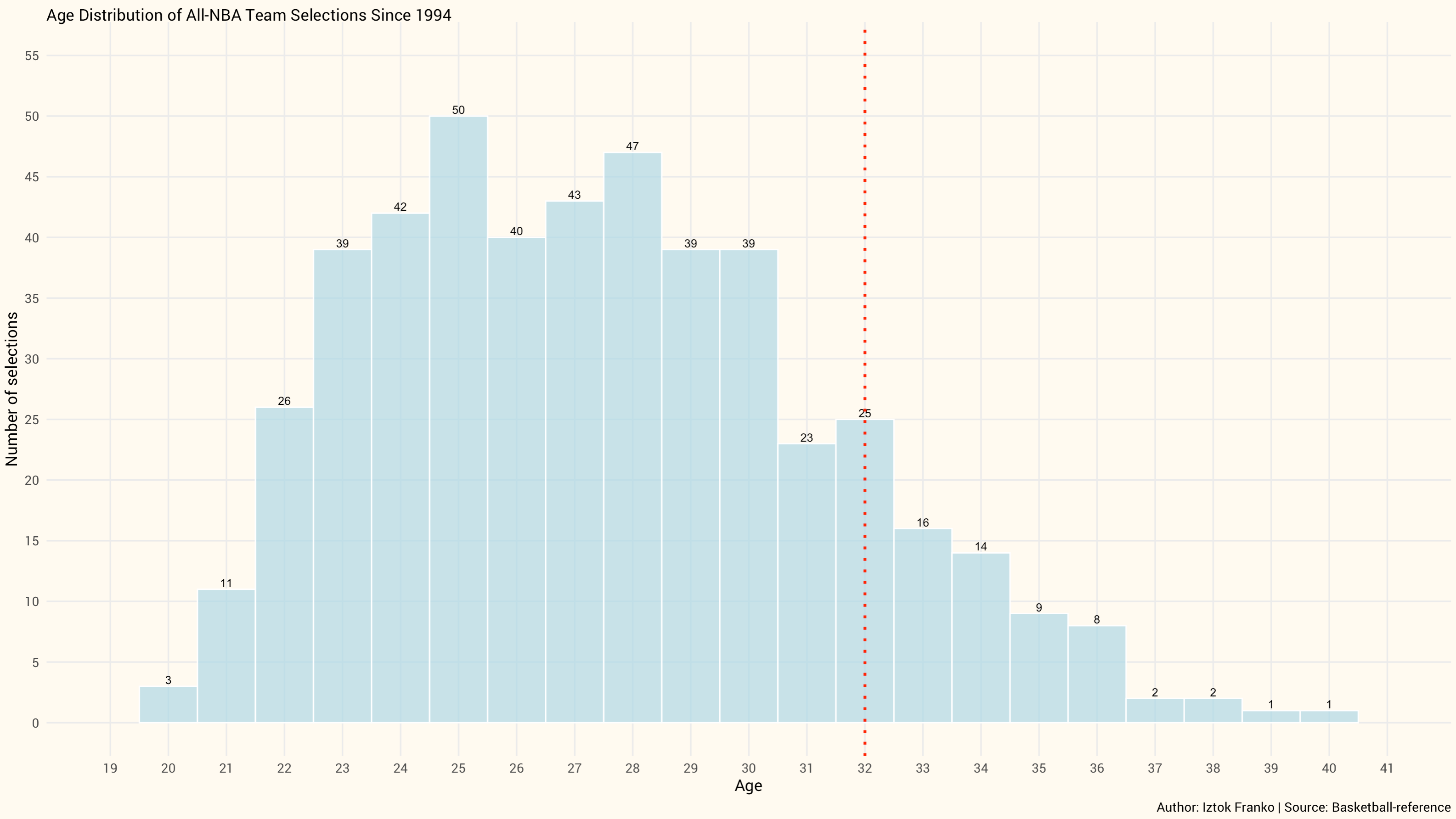
Only 78 of the total 480 spots, just 16 percent, went to players who started the season at age 32 or older. Since 1994, there have been only 36 such players, a list dominated by LeBron James (9 selections after age 32), Karl Malone (6), and Steph Curry (5).
3-Do big men peak earlier? A short and exclusive list 📊
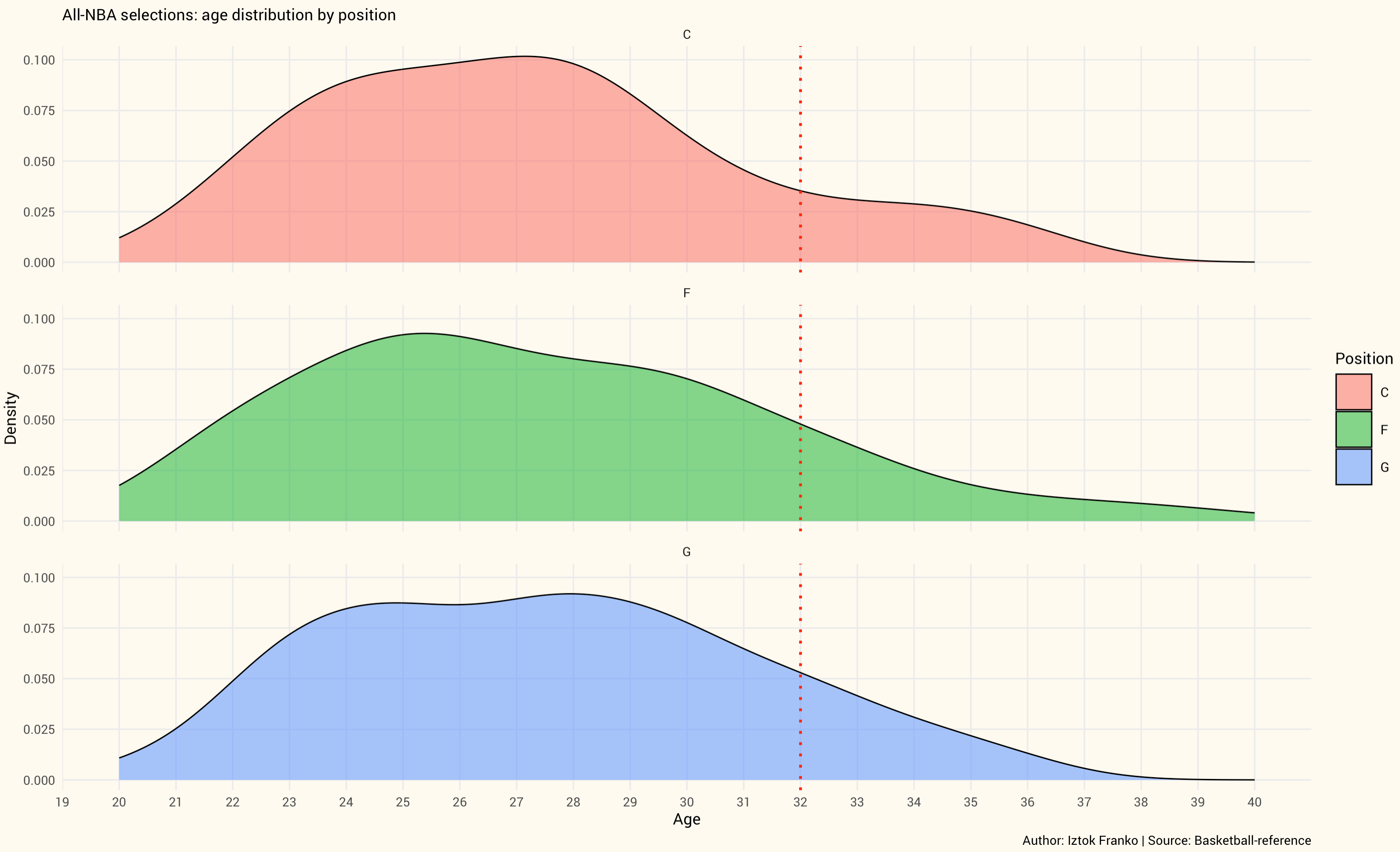
The next step in my analysis was to see if All-NBA selections differ by position, with the goal of narrowing down the research to big men more comparable to Davis. And the results do show a difference: the age distribution curve for centers signals they tend to peak earlier than, say, smaller guards.
Now, you could argue that AD isn’t a traditional center, and that the Mavericks are intent on building this next era with him at power forward, easing the physical load and wear-and-tear on his body as he nears his mid-30s.
To find historical comps for Davis, players who earned an All-NBA spot past age 32, I narrowed the list to centers and power forwards only. I excluded the wing/forward hybrids like Dominique Wilkins, Dennis Rodman, Detlef Schrempf, Scottie Pippen, LeBron James, Jimmy Butler, DeMar DeRozan, Kevin Durant, and Kawhi Leonard, who spent more time between small forward and power forward rather than operating closer to the basket like Davis and other big men.
Basically, since 1994 only 11 big men have made an All-NBA team at age 32 or older. And if you look closer, most of those selections came in the 1990s and 2000s, before today’s faster, pace-and-space NBA, in an era dominated by physical bigs.
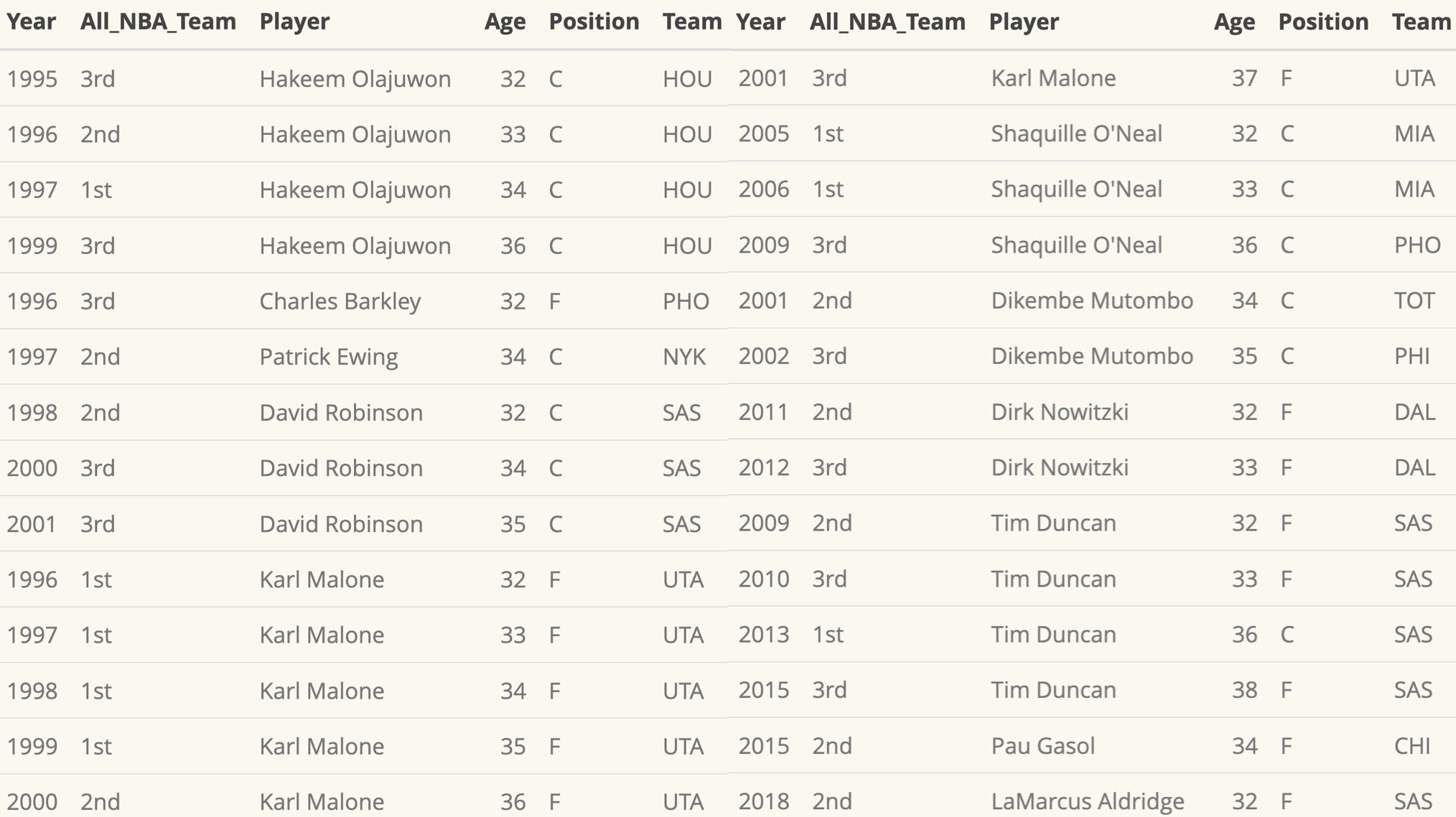
Since 2010, just four players fit the criteria: Dirk Nowitzki, Tim Duncan, Pau Gasol, and LaMarcus Aldridge—the last to do it in 2018. I think those four are solid benchmarks for comparing Davis’s age curve and eventual decline, but I also wanted to widen the scope to include defensive standouts. So I turned to All-Defense selections from the more recent era (since 2008).
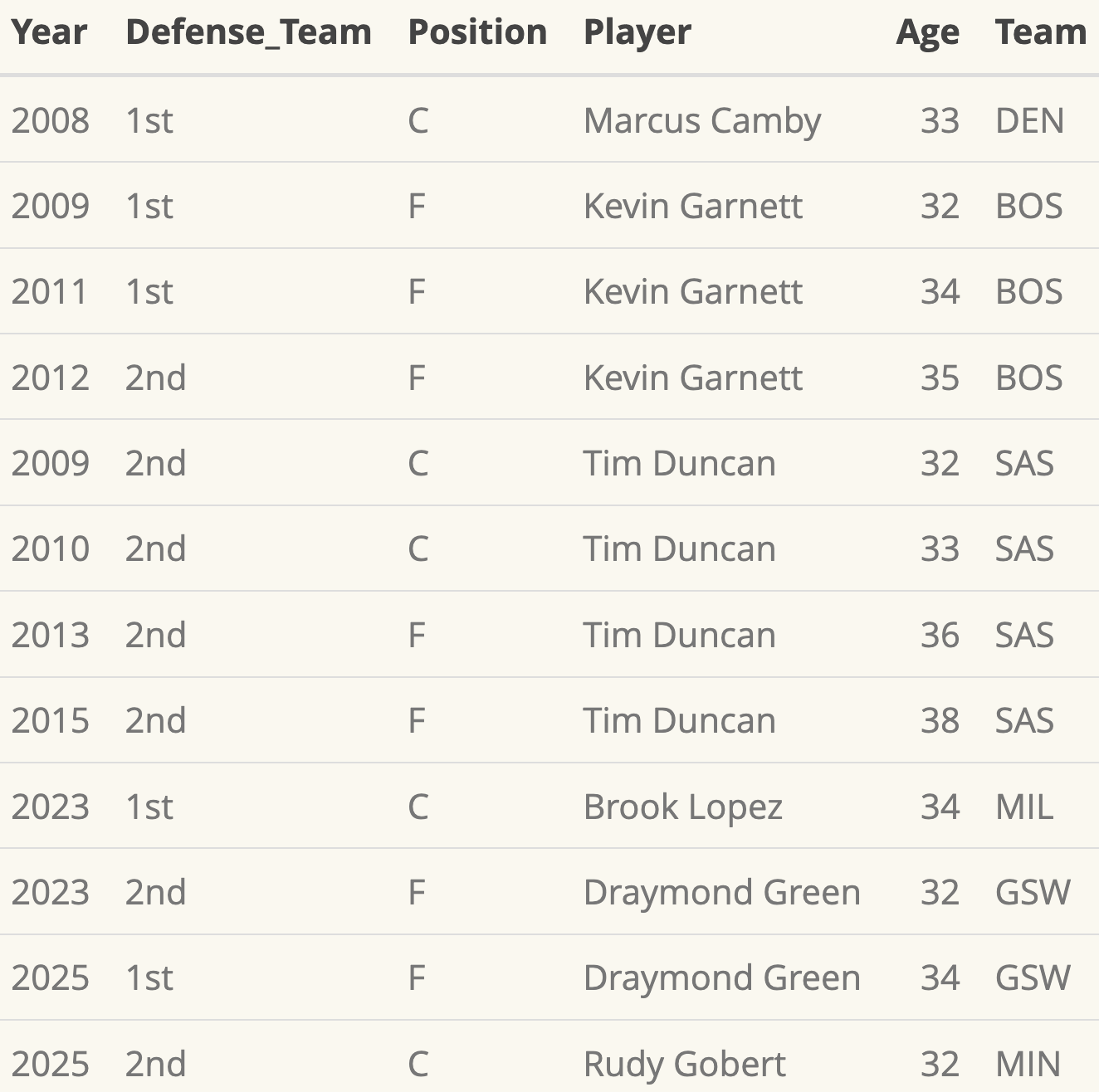
By expanding the scope to All-Defense teams, five more names join the list of players who had highly impactful seasons past age 32: Marcus Camby, Kevin Garnett, Brook Lopez, Draymond Green, and Rudy Gobert.
4-Injury history of big men who made All-NBA or All-Defense past age 32 📊
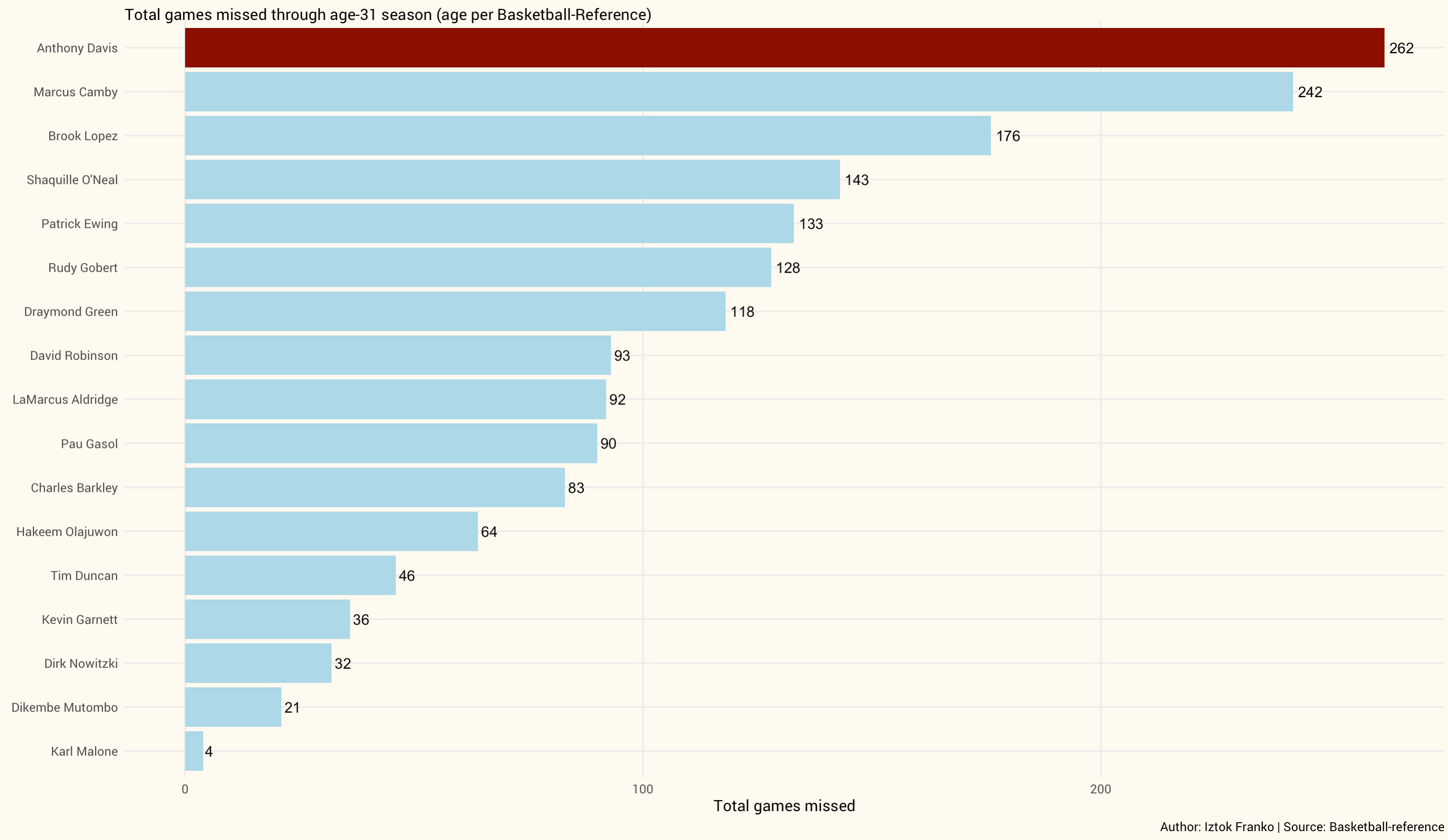
My first takeaway from the players in the previous section was that, with a few exceptions, most had been remarkably durable earlier in their careers. To check that assumption, I crunched the numbers and calculated games missed per season for each player, adjusting for shortened seasons dating back to 1984—the year the oldest names on the list began their careers.
I also calculated the percentage of games missed to account for differences in entry age, with Davis entering the league at 19 compared to Duncan at 21, Camby at 22, and Ewing at 23.
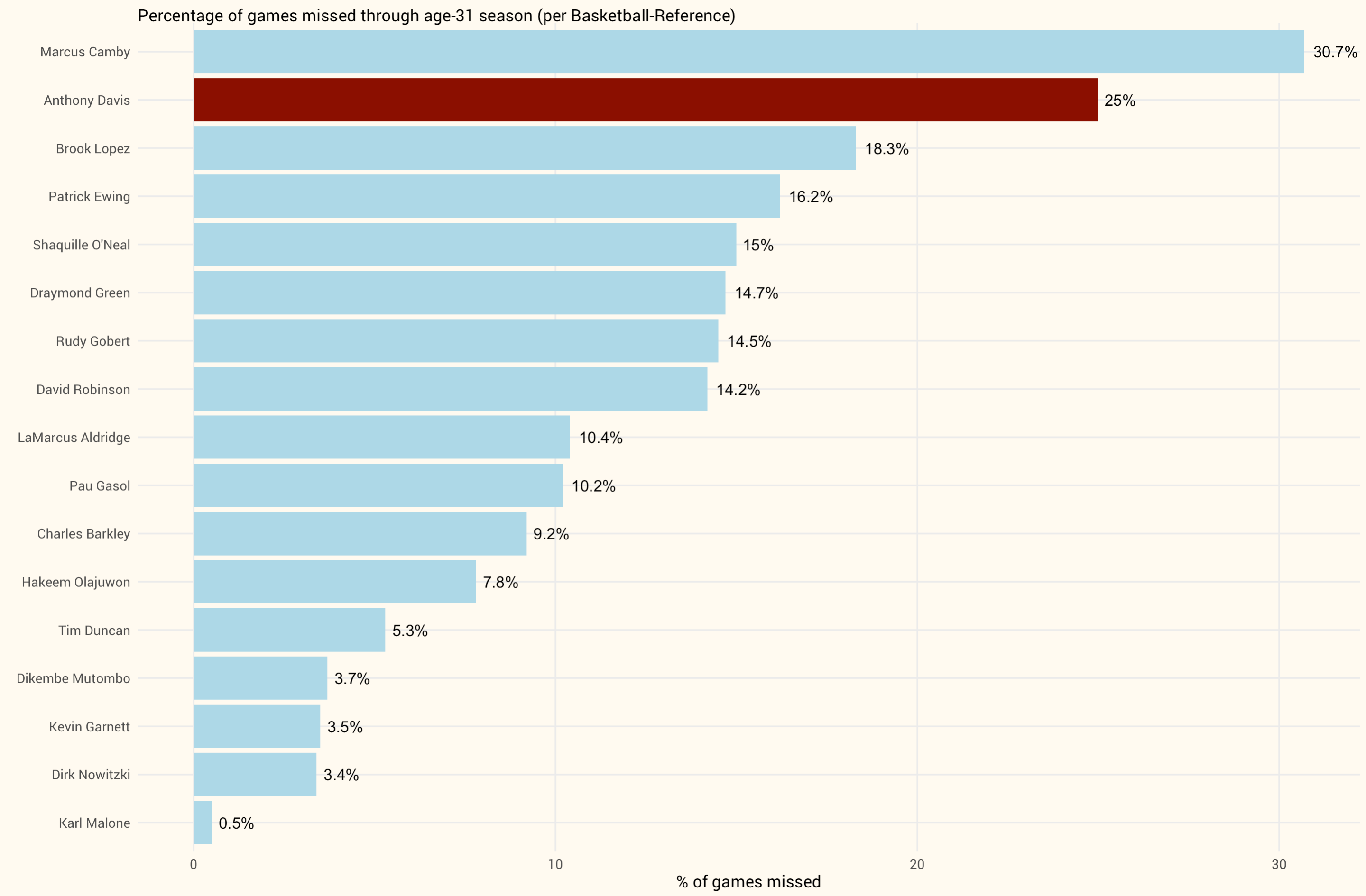
The order shifted some, but not dramatically. Most players who earned All-NBA spots past age 32, especially those who did it more recently in the modern NBA, ranked among the most durable. Davis, unfortunately, sits at the very top of the games missed list.
5-Reason for cautious optimism and the intriguing case of Marcus Camby 📊
The data so far probably makes Mavericks and AD fans uneasy, and the next chart—where I expand the list to include more recent bigs who were impactful but lacked the prolonged peaks of earlier names—won’t ease those nerves either. But bear with me for a minute.
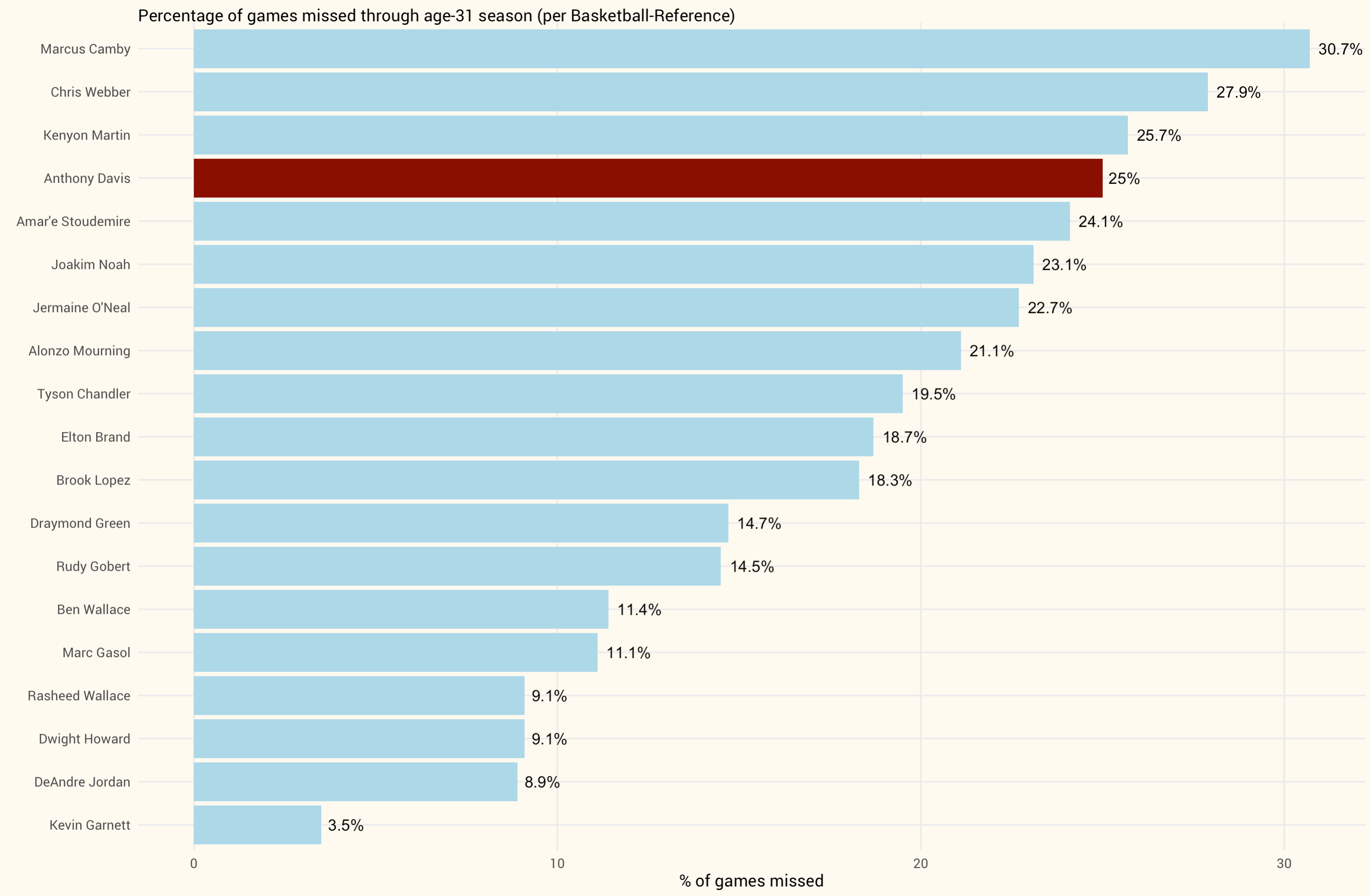
Davis is right up there among the big men who missed the most games in their careers, names like Amar’e Stoudemire, Kenyon Martin and Chris Webber. Players whose peaks, and in some cases even their careers, were cut short by an unrelenting list of injuries. But after talking to Stotts and digging through his injury database, I think the hope for Davis comes from the type of injuries he’s dealt with. Stotts has more recorded injuries for Davis than for any other big man in my comparison, yet most of them are minor. Players like Chris Webber, Dwight Howard, Joakim Noah and Jermaine O’Neal suffered major setbacks and surgeries to their backs or lower bodies. Davis, on the other hand, has had only one major body-part surgery in his career and fits more into what Stotts described as “a bunch of little stuff.”
I think Marcus Camby, one of the rare players above Davis in percentage of games missed through age 32, is an interesting reference point. Camby, like Davis, carried the label of a “fragile” big, and his career followed a similar pattern: plenty of missed games spread across seasons, but no single catastrophic injury. But Camby shed some of that reputation in his early thirties. From 2005 to 2008, ages 31 to 33, he led the league in blocks three straight years, earned two All-Defense First Team nods and one Second Team, and capped it off by winning Defensive Player of the Year in 2007 — at age 33, the same age Davis will be next spring. More importantly, he played 70, 79, 62 and 74 games in his four seasons from age 32 to 35, averaging over 31 minutes per game in each.
Now, I’m not predicting Davis will follow that exact path. The point is that there’s historical precedent for an injury-prone, athletic defensive anchor to change the narrative later in his career. There is one important distinction to note: by the time he reached his age 32–33 season, Davis had already logged three more seasons, 241 more games and nearly 11,000 more minutes than Camby. That said, no team is better positioned to manage that wear and tear than the Dallas Mavericks, who now boast one of the league’s deepest frontcourts. Davis will have the luxury of playing next to two traditional centers in Dereck Lively II and Daniel Gafford, something he’d been asking for in Los Angeles since the 2021–22 season, when his frontcourt partners were a 36-year-old Dwight Howard and a 33-year-old DeAndre Jordan. Add P.J. Washington and rookie Cooper Flagg to the mix, both natural power forwards who can scale up or down in different lineups, and Jason Kidd has plenty of options to manage Davis’ workload.
The key challenge for Kidd will be avoiding the temptation to overtax Davis as a scorer and primary offensive hub while Irving is out to start the season. With Flagg, Klay Thompson, D’Angelo Russell, P.J. Washington, Naji Marshall and others, the Mavericks should have enough depth to spread that load.
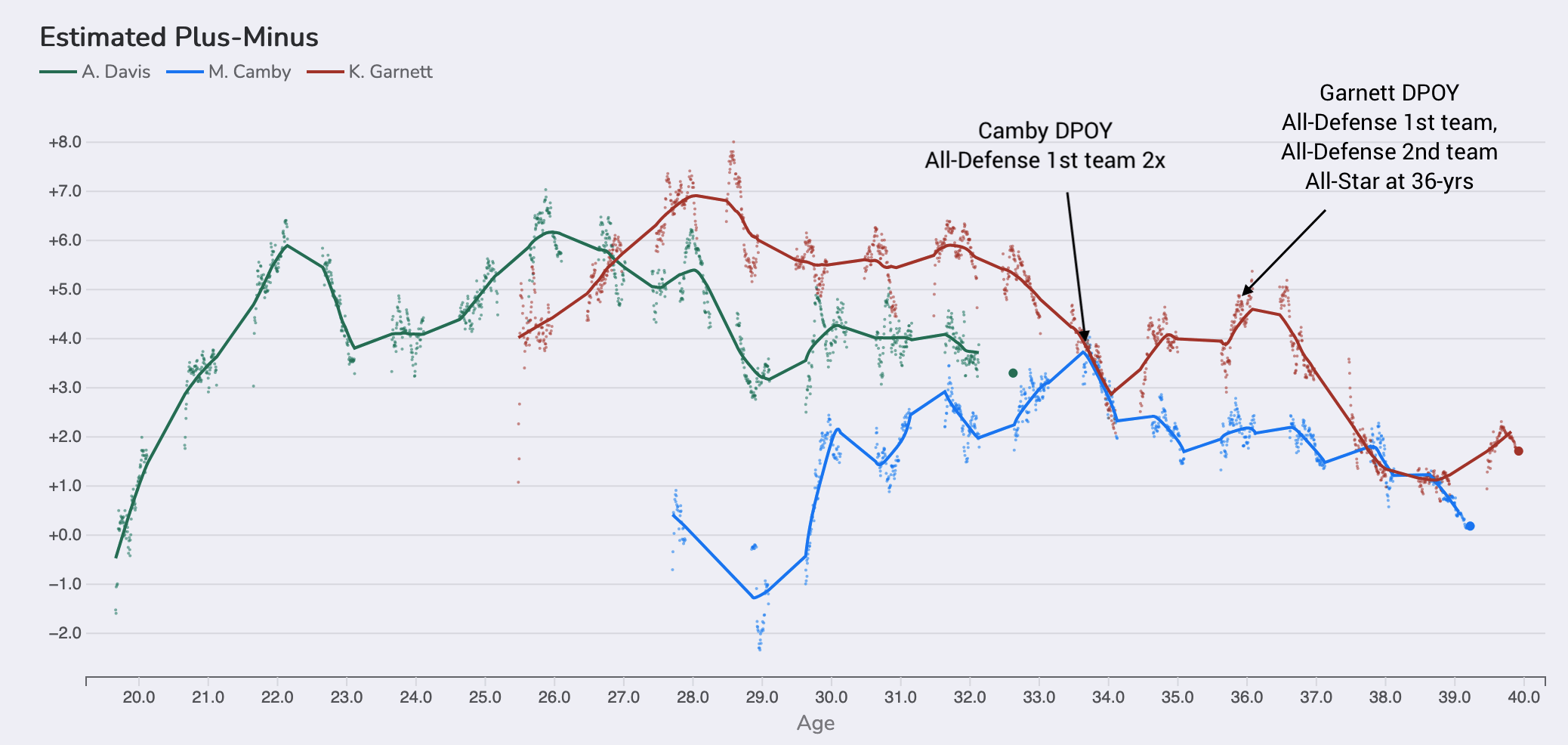
And once Irving hopefully returns to form and Flagg develops as a scorer and on-ball creator, the smarter long-term path for Davis and the Mavericks may be for him to lean fully into being the defensive anchor rather than the offensive focal point. It’s a transformation Kevin Garnett made on a similarly stacked Celtics team in his mid-thirties. Garnett, like Camby, found success in that role, earning All-Defense First and Second Team honors at ages 34 and 35, and prolonging his high-impact play well into his late 30s.
Maybe that transformation begins this season, or maybe Davis proves he can still be a two-way force and put himself back into the Top 10 conversations. The Mavericks traded for him knowing full well they were buying into a gamble, and history says the odds of sustained greatness for big men in their mid-30s are slim. The Mavericks would gladly trade a short-term peak for a longer runway of high-level play if it means the health narrative finally turns. Until then, “if healthy” will remain the asterisk attached to every conversation about Anthony Davis.
Really good article. I like your comparisons and graphics. I think you have really pointed out both the potential on both sides of this equation. This year will be a critical year for AD and the Mavs in their relationship with one another.
The gift of Cooper Flagg makes this year all the more interesting and probably really aids in managing AD's minutes. The Mavs appear on paper to be a very deep team that can play with a lot of different combinations.
I am really interested in seeing how this team moves through this year. Hope it works!