

The Main Event: A Long Overdue Cooper Flagg Deep Dive
An X’s and O’s look at what makes Cooper Flagg and the Mavericks’ future special

This one was long overdue.
I’ve spent most of this season focused on the Lakers, Luka, and the bigger picture in the West, but I never stopped watching the Mavericks. And despite genuinely enjoying Cooper Flagg, and despite several loyal readers asking for a Flagg breakdown, I couldn’t quite find the time or the motivation to do it. Maybe, as level-headed as I like to think I’ve been, the post-trade, post-Luka reality hit me with a couple of months’ delay.
But Flagg has been so good that it finally pushed me to do this properly. Instead of rushing out something half-baked, I connected with another sharp basketball mind to bring you a true deep dive. Over the summer, I worked with draft analytics expert Nick Kalinowski on a data-driven look at Flagg’s historical and future comparisons. Since then, Nick has been hired into the data department of the Denver Nuggets.
For this piece, I teamed up with my Croatian friend Toni Lazarušić. Toni is one of the best film and X’s and O’s breakdown minds I know, whether it’s EuroLeague or the NBA. He’s also one of the few people in my basketball inner circle whose brain I pick when I’m doing player scouting or simply trying to deepen my understanding of X’s and O’s. Like Nick, his future belongs on the staff of a top-level basketball organization.
This piece is an English translation of Toni’s original article on his Croatian-language Substack. I wanted to share it here because I think it’s brilliant, and because Toni’s work deserves a much wider audience.
Breakdown highlights
Role
Transition
Drives
Isolation
Pick-and-roll
Off-ball screens
Reading the game and what makes Flagg special
Cooper Flagg: the main event and Dallas’ long-term guarantee (by Toni Lazarušić)
Flagg. Harper. Edgecombe. Knueppel. Coward. Queen.
A strong rookie class, with several fairly safe future All-NBA players already showing themselves, not to mention a few more All-Star candidates waiting in the wings. But despite watching almost all of them closely, halfway through the season the situation in Dallas has interested me the most.
So let’s ask the real question. Just how real is Cooper Flagg?
I went through the film and the data in detail, focusing on how Dallas is using Flagg, the broader team context, and the skills he has already shown. This breakdown is strictly focused on offense.
ROLE
What position does Flagg actually play?
And what does “position” even mean in today’s NBA?
Basketball-Reference lists him as a small forward. NBA.com calls him a forward. Cleaning the Glass, which I trust the most, sees him as a combo guard:
78% of his minutes at shooting guard
12% at point guard
11% at power forward
That distribution also reflects the lineup chaos Dallas has gone through this season while searching for an identity. Some of that is self-inflicted, the result of unnecessary experiments, and some of it comes from injuries.
They opened the season with jumbo lineups and Flagg at point guard. Let’s be clear: when Flagg plays PG, Dallas is minus 19.1 points per 100 possessions. At shooting guard, minus 5.7, at small forward, plus 9.4.
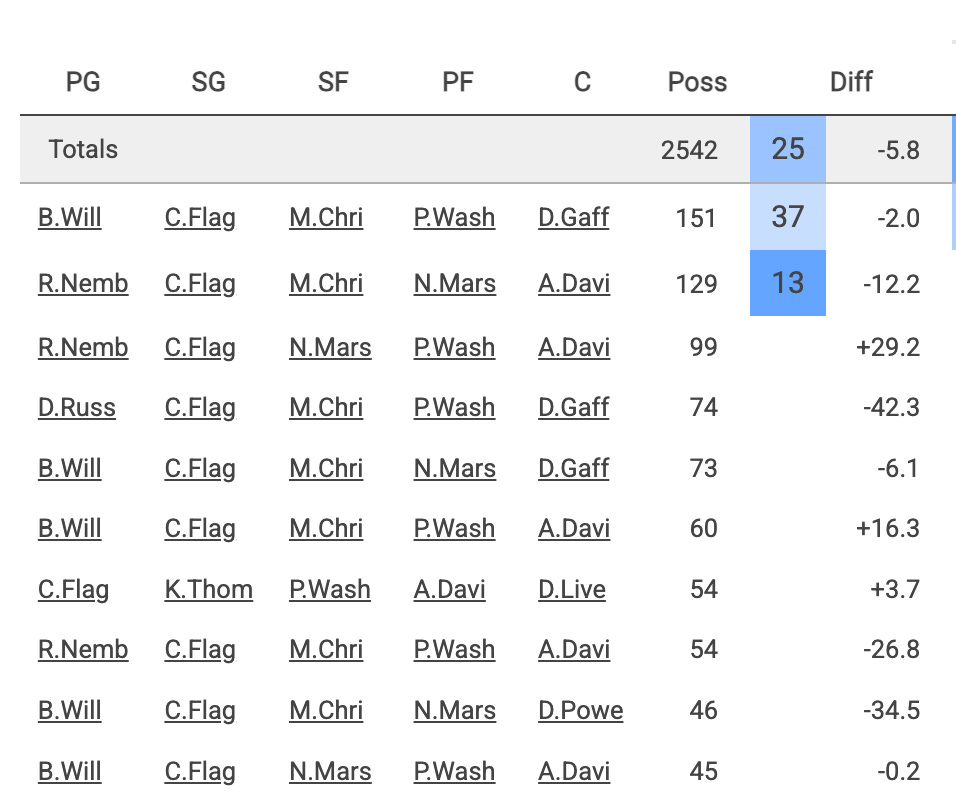
Jason Kidd quickly moved away from the idea of Flagg as a primary ball-handler, though he still sprinkles it in occasionally. Injuries and the difficulty of building functional offense with lineups featuring Anthony Davis at the four, Lively at the five, and Flagg sandwiched between Klay Thompson and P.J. Washington forced Kidd into more conventional rotations featuring Naji Marshall, Max Christie, and Ryan Nembhard.
These are Dallas’ 10 most frequently used lineups featuring Flagg:
Flagg averages 34.6 minutes, 18.9 points, 4.1 assists, and 2.2 turnovers.
He shoots 54% on twos, which is excellent given the role he’s been asked to play.
The three-point shot sits at 27% on 3.4 attempts, and he gets to the line 4.4 times per game, converting at 81%. His true shooting percentage is 55%, slightly below league average. Usage rate: 23%, essentially a third option.
Viewed in a vacuum, Flagg does not look like an efficient scorer. But that framing misses the point for three reasons:
First, he’s a rookie. Full stop. Second, his current offensive role makes efficiency difficult.
Lastly, young players shouldn’t be evaluated by the numbers alone, but by their skills and the flashes of skills they will be able to build on in the future. And that’s where Flagg is phenomenal.
TRANSITION
Some skills translate immediately. Transition play is one of them.
Flagg is outstanding running the floor. He rebounds and pushes coast to coast with ease, but not recklessly. He is great at reading the floor, finding shooters, and creating layups when advantages appear.
The Mavericks are a great fit, because they want to run. They rank 6th in the NBA in transition frequency and are among the top four teams in efficiency on transition plays following defensive rebounds.
Individually, Flagg ranks in the top 20 percent of transition finishers league-wide. Among players with a similar number of transition possessions, he’s more efficient than players like Castle, Edwards, LeBron, and Fox.
DRIVES
Flagg has a positive, aggressive edge to his game. At times it can turn into running into a wall, but in the vast majority of cases his aggression is deliberate and tied to how he reads the game.
In those transition situations, even when the defense is set with four or five players behind the ball, Flagg will still look to attack early, especially when a cross-match leaves him guarded by a smaller or slower defender. That can come from wing entries, where he often catches and immediately puts pressure on the rim or the paint.
Or, he will attack in secondary transition actions from the middle of the floor, where teammates open driving lanes for him through cuts, occupied corners, a big stationed in the dunker spot, or with fake movements and decoy actions.
You’ve probably noticed by now that the common thread across all of these offensive highlights is dribble-drive, getting downhill and attacking the rim.
That’s also the reason why I’m so high on Flagg, and why it’s easy to understand all the hype he had before entering the league.
He’s 6-foot-9 and plays to his strengths, which right now means finishing around the rim or from short range. He doesn’t force long midrange pull-ups or threes, because he hasn’t yet found his spots or shooting percentages, nor has the team consistently put him in positions to do so within the system.
Thirty-five percent of Flagg’s shots come at the rim. Another 32 percent are from short mid-range. The remaining 33 percent are split between threes and long mid-range attempts. He finishes at the rim at a 66 percent clip and converts 50 percent of his short-range shots, which are strong numbers given the volume.
I also took a closer look at his drive data, and in several areas he already ranks near the top of the league.
Flagg averages 12 drives per game, which ranks 31st in the NBA. Out of those drives, he generates 6.6 shot or finishing attempts per game, the 12th-highest mark in the league. From those 6.6 attempts, he scores nine points per game on 56 percent shooting. Among players with six or more shot or finishing attempts off drives, only SGA, Jaylen Brown, Dončić, Mitchell, Herro, and Edwards are more efficient by percentage.
In other words, Flagg is already a finishing force, and along with transition play, getting downhill is his most dangerous weapon.
ISOLATION
Dallas’ offense, overall, is a tough watch. Right now, it ranks 28th in the league. Even the Brooklyn Nets are more effective, and they’re playing with what feels like three and a half NBA players. No team in the league shoots the three worse than Dallas at 33 percent, which tells you a lot about the context Flagg is operating in. Add to that the fact that Jason Kidd and his staff are not exactly the most creative offensive minds, and Flagg often finds himself forced into pure improvisation.
That improvisation most often comes in the form of isolations. It’s a direct consequence of the lack of guards or high-level triple-threat creators next to Flagg. When Dallas inserted Nembhard into the starting lineup, it didn’t move the needle much, but it did provide a small boost in the form of a competent guard who can handle basic playmaking duties, which helped Flagg, Davis, and others. Even Brandon Williams, realistically a backup or third option, sometimes looks like an NBA starter simply because he can bring a bit of structure and coherence to Dallas’ offense (everyone except D’Angelo Russell, of course).
There’s one more Flagg-related number worth highlighting. Only 43 percent of his made baskets are assisted, which says a lot about the system and roster he’s playing in. Yes, Flagg is clearly destined to become a creator for himself and others, and the reps he’s getting now matter as part of that development. But he badly lacks a reliable guard or creator who could unlock more combination play. Nembhard is fine, but both he and Williams are players you can comfortably go under the screen in pick-and-roll actions, which limits the options.
Because of that lack of guard creation, especially when Davis is out, Flagg is often forced into isolations at the elbow or at the top of the floor.
He scores just 0.86 points per possession in isolation, which is below average, but in this case I care more about the process than the numbers. Flagg attacks aggressively off the dribble, looks to get all the way to the rim or into short range, and then creates finishes with spins or step-throughs. I much prefer that to watching him settle for one jump shot after another.
It’s also easy to notice that although Flagg is right-handed, the vast majority of his drives and finishes come going left. Even without an exact number, it’s clear he’s very comfortable finishing with both hands in the paint or at the rim.
PICK-AND-ROLL
This is the part of his game that intrigues me the most, and again it ties directly into his on-ball creation. The numbers show that Flagg averages 5.1 possessions per game as a pick-and-roll ball-handler. From those situations, he scores 0.85 points per possession, which puts him right around the 50th percentile, essentially league average.
In this context, we’re mostly talking about pick-and-rolls with centers setting screens that allow him to go left. Against the Kings, in one of the Mavericks’ more recent games, he was given a larger share of possessions as a PnR creator and showed what this could look like going forward when defenses give him space by playing drop coverage or going under the screen.
Beyond the scoring, Flagg has also shown a genuinely impressive level of playmaking. He reads defenses well. The reads are still basic, sure, but he makes them. He sees when the center is open for a lob, knows when he can slip the ball through for a layup or a short roll, spots shooters in the corner and fires the skip pass, and recognizes when the defense collapses from one pass away and kicks it out to an open shooter.
I don’t think it’s realistic to expect much more than this from a rookie wing playing in such poor spacing.
One of the bright spots in how the Mavericks has used Flagg is the inverted pick-and-roll, which we see a few times per game. In those actions, guards screen for Flagg, creating mismatches that he can attack. At the same time, he’s aware enough to recognize when the switch also creates a mismatch for the center in the post and is willing to make that pass as well.
OFF-BALL SCREENS
As for the bright spots, Dallas does run a few sets designed to free Flagg without the ball. That’s a great way to ease the burden on him and put him in better scoring situations. These aren’t clean layups or automatic baskets. Flagg still has to work and do most of the heavy lifting to score, but that’s enough. The system creates the initial advantage, and the rest is up to him.
I’ll just leave these two actions here.
Wide:
Elbow hand-off:
READING THE GAME AND WHAT MAKES FLAGG SPECIAL
To wrap it up, I want to highlight a few more things that I think really capture Flagg’s feel for the game, his understanding, and his overall versatility as a player.
Cuts:
Because of Dallas’ style of play and the limitations of the roster, Flagg doesn’t get many opportunities to showcase his off-ball movement or be consistently rewarded as a cutter. But when he does recognize an opening, he takes advantage of it and picks up a few easy points.
Passing:
I’ve already shown some of Flagg’s playmaking reads out of transition and pick-and-roll, but there’s more. He recognizes teammates with mismatches, punishes defenses sitting in the gaps, throws skip passes against rotations, feeds the center after attacking closeouts, and makes the right pass against zone defenses.
Problem solving:
I watched Dallas play Portland a few days ago. As expected, the Blazers stuck Toumani Camara on Flagg, fronting and denying him touches and making it difficult for him to even catch the ball, which quickly took the life out of Mavericks’ offense.
Flagg adjusted much better in the second half and was able to get himself going. From that game, and another one against the Pistons, I pulled four sequences that should leave no concern in Dallas about the future of the franchise. Coop is their guarantee that everything will be okay.
In those clips, the 19-year-old was stopped on two possessions that neither he nor the team executed particularly well. Then, on the very next possessions, he came back and did everything much better. In any case, see for yourself.
There are so many positive indicators in Flagg’s game that the 28 percent he’s shooting from three over the first couple of months of his NBA career doesn’t worry me at all. The percentages will come. He didn’t have issues shooting the three in college. The mechanics are a bit unconventional, but there’s no glaring flaw that has already been flagged as a long-term concern.
Right now, the bigger factor with his three-point shooting is shot profile rather than ability. Most of his attempts are coming off the dribble, with fewer spot-up or pick-and-pop looks. On top of that, he’s still adjusting to the longer NBA three and to faster, longer defenders closing out on him.
And even within those rough percentages, you still see flashes of brilliance, whether it’s genuinely deep pull-up threes or shots coming off drag screens in secondary transition.
I understand why so many people are excited about Kon Knueppel and his efficiency in the Rookie of the Year race, but for me, what Flagg is doing is on a different level. Because of the three-point shot, I can’t say he’s a finished product yet, but he will be.
A player who will be able to score with ease and make the teammates around him better.
The Maine Event.
Great article. The focus on the offensive end was really well done, and the video examples were really helpful in demonstrating Coop's ability to learn not only as the season progresses, but also even within a single game. His ability to see the game and learn it seems remarkable for a 19-year-old player.
I totally agree with you that the Mavs coaching staff does not seem to have much of an offensive strategy. That may be the result of a very ill-fitting team, but they really don't seem to have very good offensive sets that they run (or perhaps really no offensive sets at all). There is a lot of name recognition on the coaching staff, but they don't seem to have a great offensive (or defensive) philosophy. Perhaps they want to just free-lance, but the lack of real point guard play seems to be a drawback to that style. I am a fan of both Nembhard and B-Will, but neither is a true starting point guard. Both are overexposed in that role, which leads to a lot of indecision offensively.
I believe that Flagg's defensive ability also really bodes well for the future.
Thanks for a really enjoyable read!
next level stuff, here. great work