

NBA MVP Race: The Undervalued Power of Infrastructure
Chemistry, continuity, and the hidden edge behind this year’s MVP race

The NBA season is coming to an end, and we’ve got one of the tightest MVP races in recent years.
There are four legitimate candidates, five if you ask the media in Boston, all putting up historic individual seasons while leading winning teams. Every one of them is on pace for 50+ wins, with two likely even crossing the 60-win mark. That’s usually enough to separate a winner. This year, it doesn’t.
Before getting into the deeper dive, it’s worth saying this clearly: Shai Gilgeous-Alexander, Nikola Jokić, Victor Wembanyama, and Luka Dončić all have real MVP cases. If any of them wins it, it will be deserved.
Now, full transparency. I’m Slovenian. I watch the Lakers closely. I’ve spent years following Dončić. So yes, I’m biased, especially when it comes to appreciating some of the unprecedented things he’s been doing this season.
At the same time, the way he’s been covered in parts of the media has stood out. And not in a good way. A lot of the conversation has felt biased, incomplete, often missing key context around the season, the roster, and how his and other MVP candidates’ teams were actually built.
And even now, with the Lakers surging, there’s still one part of the MVP discussion that feels underexplored, even among the more argument-driven, analytics-heavy crowd. That’s the angle I want to lay out in this column.
Today’s highlights:
All candidates but one have had teams and systems built around them for years
Lineups, plus-minus, and advanced metrics
The scientifically proven effect of chemistry and familiarity
The reason behind the Lakers’ and Dončić’s late surge
Past chemistry, but what about future certainty?
1-All candidates but one have had teams and systems built around them for years
I've been preaching about the value of continuity for a long time, even proclaiming it as the most underrated trait of contenders during last year's playoffs.
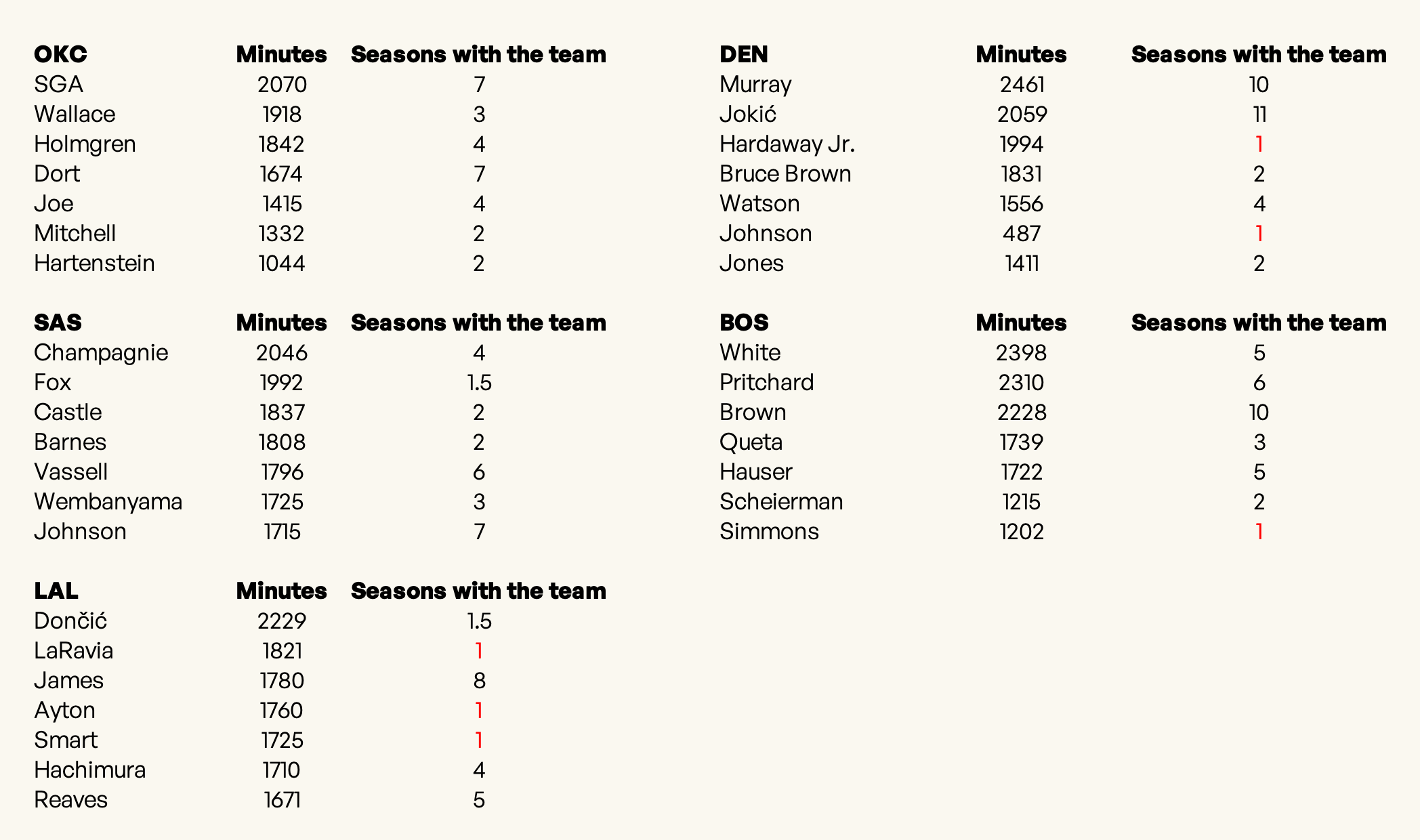
If we look at the top five teams in the NBA by point differential, which I’m using because it’s an important part of my next point and a metric often used in MVP arguments, Thunder, Spurs, Pistons, Celtics, and Knicks are all teams that have had their infrastructure and core in place for at least a couple of seasons, in some cases even longer. Or if we look at it from our MVP candidates’ perspective:
Shai Gilgeous-Alexander: his 7th season in Oklahoma City, a span that included two tanking seasons and two more developmental years. The core pieces, SGA, Chet Holmgren, and Jalen Williams, have been together for four years. Luguentz Dort, the key perimeter defender and partner, has played with SGA for seven years. No new players were added before the season, and only one minor move was made at the deadline. This is as long-term and as solid as the infrastructure can get. Well, maybe the next one is an argument against that.
Nikola Jokić: his 11th season in Denver and his 10th playing with the second-best player, Jamal Murray. They waited patiently to find the optimal role player next to the star duo, and Aaron Gordon has been that piece for six years now. Christian Braun is in his fourth season in Denver. They added three new players this season in Cameron Johnson, Tim Hardaway Jr., and Jonas Valančiūnas (I’m not counting Bruce Brown, who returned), and had a lot of injury absences to navigate. However, Jokić and Murray are top two on the team in total minutes, and they are the infrastructure and the system on their own. The duo has more than 16,000 minutes together on the floor under their belt and are the modern version of John Stockton and Karl Malone when it comes to familiarity and continuity.
Victor Wembanyama: this is his third season in San Antonio, but ever since the Spurs won the lottery in May 2023, everything has been about how to build a contender around the French prodigy. They tanked and spent two seasons on development, then got more lottery luck, adding two No. 2 picks in Stephon Castle and Dylan Harper. Two athletic guards and ball-handlers to complement Wembanyama’s paint-terrorizing defensive skills. They traded for De’Aaron Fox last season to add another on-ball creator. Their three young wings, Devin Vassell, Julian Champagnie, and Keldon Johnson, have all been on the team since before Wembanyama was drafted. None of their offseason additions, Harper, Luke Kornet, or Carter Bryant, is in the top seven in total minutes.
Jaylen Brown: this is the best case for why infrastructure matters. Brown is in his 10th year in Boston. The other two top players and leaders in total minutes, Derrick White and Payton Pritchard, have been Brown’s teammates for five years or more. None of their top five players in total minutes have been there for less than three years, and they have one of the most well-defined systems they don’t deviate from, no matter what.
Luka Dončić: it’s been 14 months since Nico Harrison shocked the basketball universe by trading Dončić to the Lakers, a team that was built around a 40+ year-old LeBron James and the unique defensive talents of Anthony Davis. A team that, apart from Austin Reaves, had no young building blocks, and a team that decided to punt last deadline and offseason with stopgap moves, planning to build around Dončić next summer. A team that added two new starters from the buyout market last summer and a third piece, Jake LaRavia, on a low-value deal. LaRavia was projected as the 8th or 9th man and is second on the team in total minutes.
2-Lineups, plus-minus, and advanced metrics
All MVP candidates are putting up incredible box score numbers, so the analytics-driven part of the argument often shifts to advanced metrics. And most of those metrics, in one way or another, are built on adjusted versions of plus-minus and on/off data, trying to isolate a player’s impact beyond raw production.
I consider myself a data-savvy analyst and use advanced numbers to perform analysis and validate my hypotheses. But one thing I’ve learned over the years is that lineup data, as the name suggests, is heavily dependent on the broader team context, the five players on the court and the ten others on the bench.
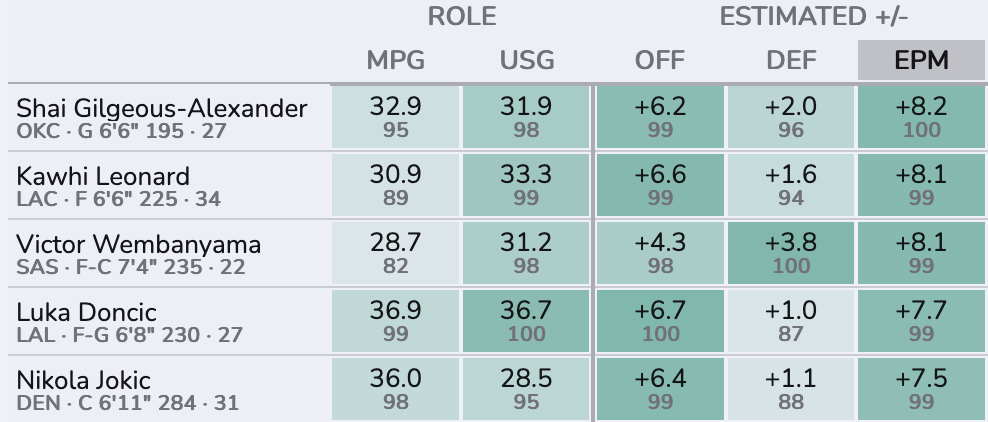
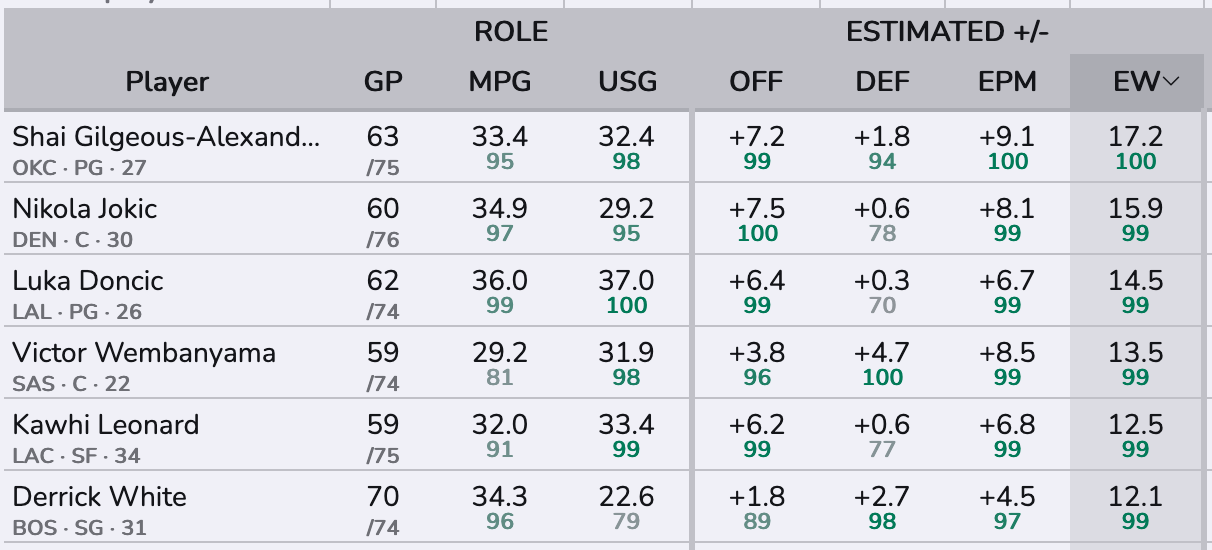
While I don’t think it’s a coincidence that Gilgeous-Alexander, Jokić, and Wembanyama stand out in per-100-possession impact metrics, I do believe there is a lineup boost from continuity, and even more from playing a vast majority of minutes in good to great, balanced lineups.
For example, Nuggets lineups with Jokić, Murray, and Gordon are +20.3 per 100 possessions on 880 possessions this season. Jokić, Murray, and Braun lineups are +13.1 on 1,745 possessions. Examples of strong balance and several years of continuity. Spurs lineups, with their three complementary pillars, Wembanyama, Castle, and Vassell, are +21.5 per 100 possessions on 1,437 possessions. Swap Castle for another young athletic guard, Harper, and that jumps to a ridiculous +44.9 on 447 possessions. You can find a similar pattern in Thunder lineups. Units with SGA, Holmgren, and Cason Wallace, again a complementary and balanced build with a playmaker, perimeter stopper, and anchor big, have a +20.9 point differential on 1,383 possessions. You can swap Wallace for Caruso and that jumps to +31.4, or for Dort and the differential is +17.2. You can see where a significant part of the surplus in plus-minus is coming from.
The Lakers have one awesome three-man combination. Lineups with Dončić, Reaves, and Smart are +22.1 per 100 possessions on 976 possessions this season. Smart has been the best player when it comes to on/off data, and it’s not difficult to figure out why. He’s the only above-average, even very good defender on the team with an All-Defense pedigree, while, for example, the Thunder have four of those just on the perimeter in Dort, Caruso, Williams, and Wallace. If you add two great defensive bigs in Holmgren and Hartenstein, there are countless ways to build strong defensive lineups.
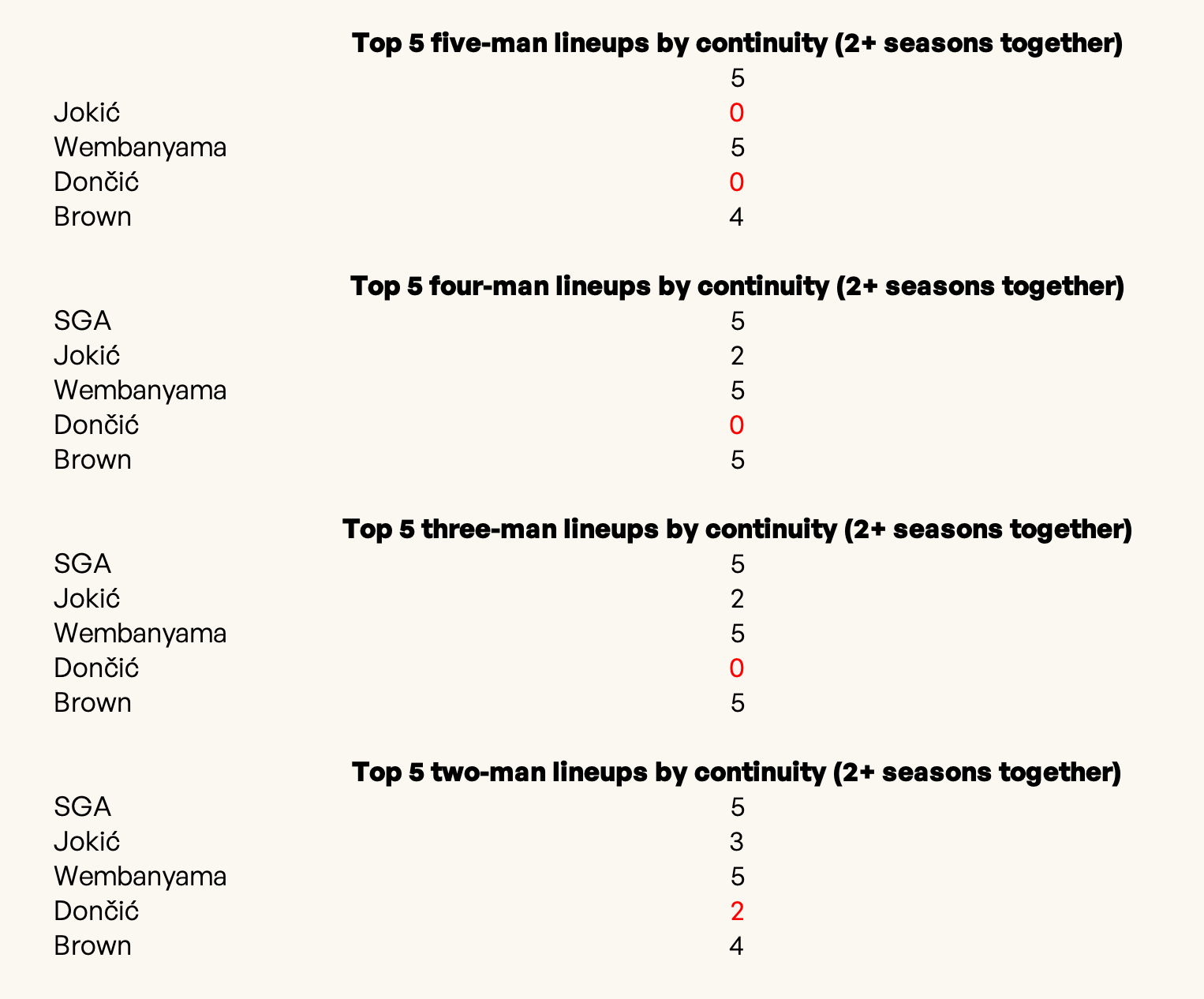
If we add the continuity aspect to it, you can see how Dončić and the Lakers had a lot of figuring out to do earlier in the season. Below are the top five five-, four-, three-, and two-man lineups by continuity for the top MVP candidates. As you can see, all of the top five most-used permutations of Dončić’s five-, four-, or three-man units include at least one, if not more, players who joined the team last summer.
3-The scientifically proven effect of chemistry and familiarity
If you think chemistry and continuity don’t matter, or at least not as much as I’m making them out to, there’s actually a body of research that says otherwise.
Work presented at the Sloan Sports Analytics Conference and similar academic studies has shown that players tend to perform better when they share more minutes with the same teammates. Offenses can become more efficient, decision-making improves, and turnovers go down. Other models highlight that player impact is heavily context-dependent, meaning performance is not just about individual talent, but about who you share the floor with and how well those combinations have been built over time.
A Stanford machine learning project approached this from a different angle, modeling NBA outcomes using player chemistry as a measurable factor. The model captures pairwise synergy between teammates, estimating how much two players improve team performance simply by playing together. Using only player combinations and historical co-occurrence, it was able to predict game outcomes at a solid level, while showing better stability across seasons than models based purely on individual talent. The key idea was simple: chemistry builds through repetition, and longer, more consistent pairings allow that synergy to manifest, improving outcomes like win percentage, which correlates strongly with point differential.
Most recently, a similar idea was explored at the Sloan Sports Analytics Conference by the godfather of NBA analytics, Dean Oliver, and Ben Alamar in their presentation “Lessons in Chemistry: Impact of Teammate Familiarity on Shooting in the NBA.” Their work looked directly at how teammate familiarity impacts shooting efficiency using several seasons of play-by-play data. The findings are intuitive but powerful. As players log more reps together, especially in actions like passes into shots, efficiency improves. Teammates learn timing, preferred spots, and movement patterns.
The implication is that familiarity impacts both shot selection and shot-making accuracy, creating a multiplicative effect. When you play with the same teammates, you start to anticipate when and where your shots will come.
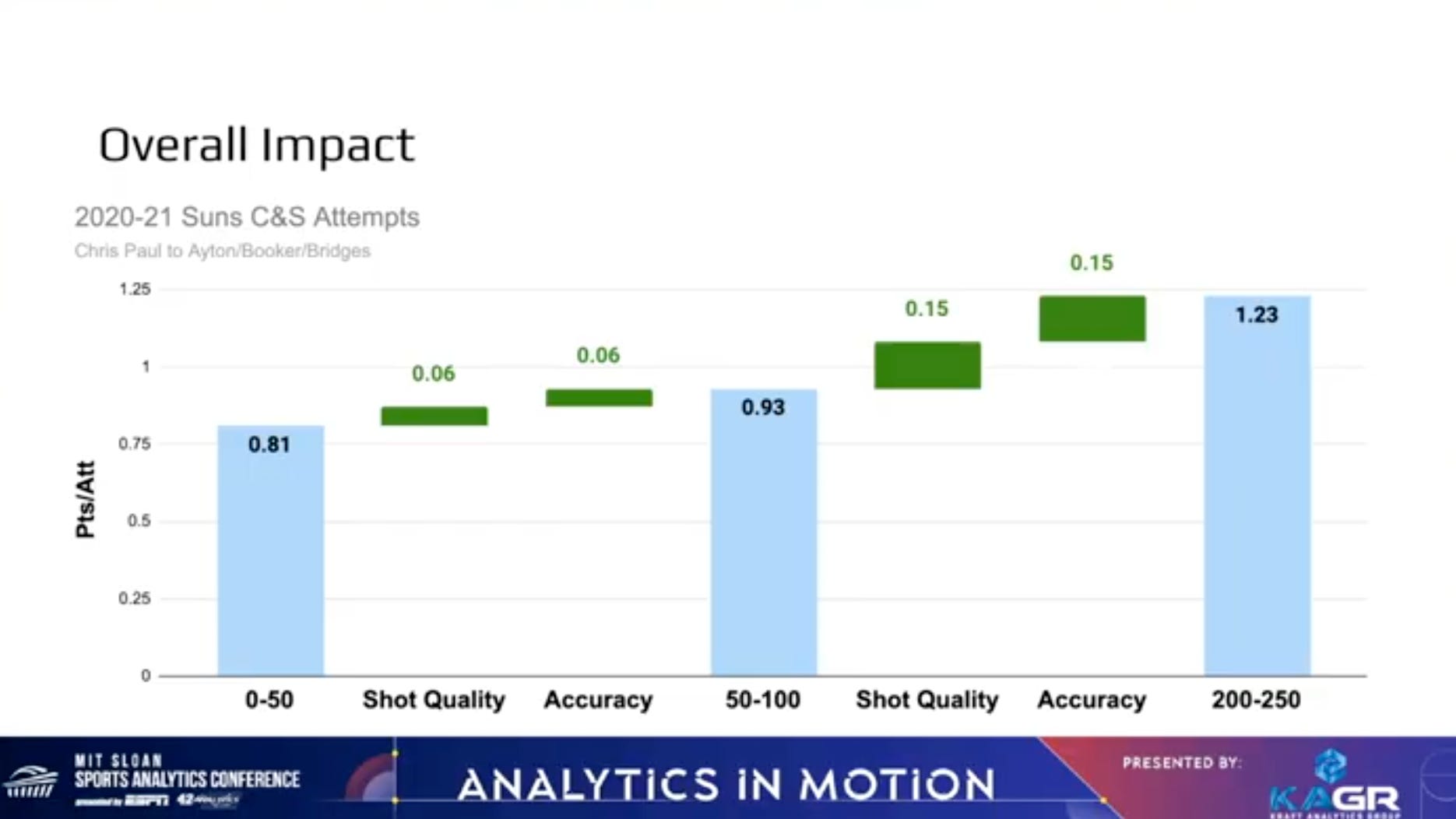
That chemistry is still not captured in existing shot quality models, but it clearly shows up in the results. And one can imagine that if chemistry translates to shot quality, a similar effect can be expected on the defensive end, where understanding teammates’ tendencies, communication, and trust in executing complex coverages are even more crucial.
4-The reason behind the Lakers’ and Dončić’s late surge
Reading the above, it’s not difficult to understand why the Lakers made their recent run, winning 14 of their last 16 games, so late in the season. I broke it down with numbers and key milestones in my 70-game check deep dive, but to sum up a long read, it came down to two things:
a.) health
b.) lineup clarity, continuity, and balance
LeBron James and Austin Reaves both missed a significant part of the first four months of the season. The Lakers’ top five in minutes through January 31st were Dončić, LaRavia, Ayton, Hachimura, and Smart. All three offseason additions were in the top five. Once the Lakers got healthy and with a relevant sample size of the new players and their best roles, JJ Redick was able to identify the best starting unit and clarify the rest of his rotation, despite the late addition of Luke Kennard, who is fifth on the team in total minutes post-deadline. After a recent practice, the two big men tasked with anchoring the defense while being the main screen setters on offense, Deandre Ayton and Jaxson Hayes, both highlighted reps and chemistry as key to the Lakers’ recent success. The most important factor for the offensive improvement, one I identified in my aforementioned 70-game check, has been a significant reduction in turnovers, which can be directly attributed to chemistry, continuity, and role clarity.
Over the last twenty games, Redick has settled on his current starting unit of Dončić, Reaves, Smart, James, and Ayton. That group has now played almost 400 possessions together, with a point differential of +11.4 per 100 possessions, an impact much more reflective of the league’s best units. Once that happened, Dončić’s on/off numbers, +12.0 per 100 over the last 15 games, are in the same category as the other three candidates in the MVP race. That is still without a roster built around him and without the skill set needed to fully optimize his impact.
5-Past chemistry, but what about future certainty?
There is another psychological aspect that affects team composition that the analytics papers I mentioned don’t cover. They focus on chemistry and familiarity, which are byproducts of the past. But what about the future?
The real power of infrastructure is that it provides clarity and vision for what comes next. Looking at our four MVP front-runners, you can see the other three not only have familiarity, but also clarity around future key building blocks around their stars, reflected in long-term contracts.
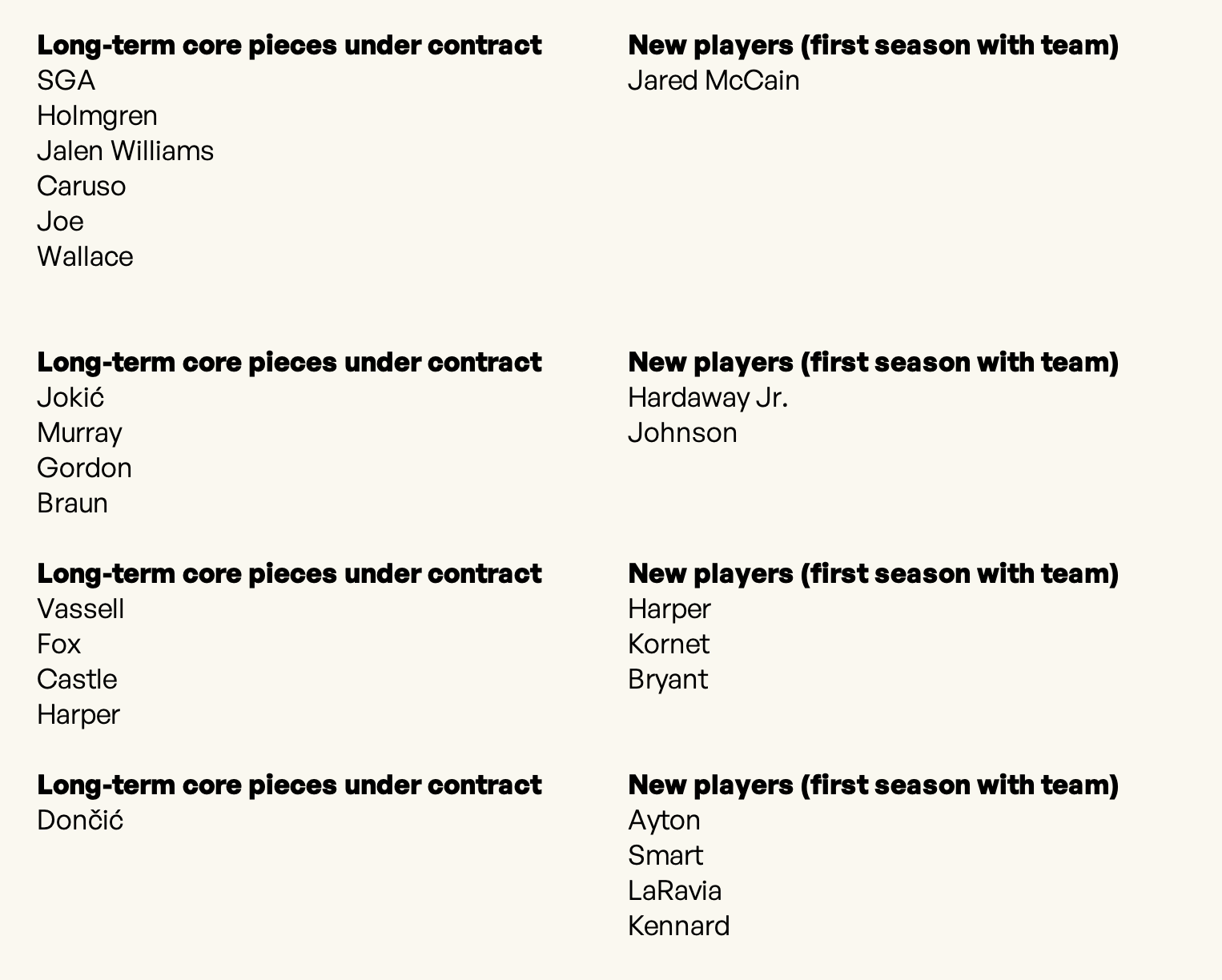
Dončić and the Lakers are the clear anomaly, a team where, besides Dončić, no other key player has a contract or clarity for next season. One could say Austin Reaves is the only long-term piece next to Dončić on the roster, but even he is an upcoming free agent, with all the uncertainty that comes with that.
The Lakers have managed to overcome some of that roster instability recently, to the huge credit of Redick and the coaching staff. But there is no doubt that it is much harder to make the sacrifices required for consistent winning basketball, the kind that eventually shows up in plus/minus and point differential, when almost every player is effectively auditioning for his next contract.
If you look at the best team Dončić has had, even in a relatively short stretch, when he was surrounded by a high level of complementary talent and what at the time looked like future clarity, the 2024–25 Mavericks, their point differential and Dončić’s on/off numbers were again on the level of the top contenders, even projecting to a 58-win team.
I’ll say it again. All of these guys are deserving MVPs, and honestly, the debates and case-building are part of the fun. This was my attempt to highlight one part of the conversation that often gets overlooked, and one that, in my view, matters more than we admit when evaluating Luka’s season.
This is really great work, Iztok, and such a powerful case for why Luka deserves to be in that conversation.
Jaylen Brown tweeted something about winning 50 games for what was supposedly a gap year and that made me think about how much of his case for MVP is overcorrection from the media. They made that assumption about this year’s Boston team that to me, even without Tatum, had the makings of a playoff team. It’s like very little evaluation actually takes place beyond “are they better/worse than I expected them to be?” and they’re just rewarding teams/players based on how much they exceeded their preconceived expectations.
Yeah really Great Iztok ! You are the best! USA Media would never 👎 Analyse 📈 it this way! And Chris mannix is even using wrong Numbers ! Great Observation! Let SGA win and let jokic get his dribble Hand off assists ! Wemby all his Blocks ! Luka gets Finals mvp in a 7 Game Finals win against the Celtics