

Lakers Offseason Series: Salary Overview of NBA Top Teams
And what does Knicks success say about potential Lakers decisions this summer?


As we continue with the Lakers Offseason Series, we will keep taking a deeper look into the league landscape, the Lakers’ challenges, and the options and decisions facing the organization heading into a crucial offseason.
Earlier in the series, I wrote about the two dominos that will likely define everything else that happens this summer.
The first is the Giannis Antetokounmpo question. If the unlikely opportunity presents itself, should the Lakers try to get into the sweepstakes? And if so, should they even pursue it?
The second domino is the much more immediate and complicated LeBron James situation. Will the Lakers and James find a way to continue their partnership for another season at a number that makes sense for both sides? Or could the organization decide it is finally time to fully hand the keys to Luka Dončić and begin building the next version of the franchise around him?
My argument for that unlikely latter scenario generated plenty of discussion. One of the most common responses was simple: how do you realistically replace LeBron James? It is a fair question, and one I plan to explore in more detail in a future article, because I think there are pathways for the Lakers to use their long-accumulated flexibility to add multiple long-term pieces around Dončić and Austin Reaves.
Before we get there, though, I think it is worth taking a step back and looking at a bigger question.
How are the NBA’s best teams actually building their rosters today? More specifically, in the new apron-driven NBA, how is the money distributed across a contender’s roster? And what lessons, if any, can the Lakers learn from the team currently up 1-0 in the NBA Finals?
Today’s highlights:
A look at salary distribution across the NBA
The Lakers' missing middle class
The blueprint and hope from the Knicks model
1-A look at salary distribution across the NBA
Watching the playoffs, and especially the epic seven-game battle in the Western Conference Finals, there was constant discussion about the depth and roster construction of the two young juggernauts from San Antonio and Oklahoma City. You can even add Detroit to that conversation, another young team that reached the 60-win mark during the regular season and appears to be built for sustained success.
But this wouldn’t be digginbasketball if we stopped at the surface-level discussion of depth, youth, and talent. Instead, let’s dig a little deeper into how these rosters are actually built. More specifically, let’s look at how money is distributed across NBA rosters and whether there are any other patterns hiding behind the league’s most successful teams.
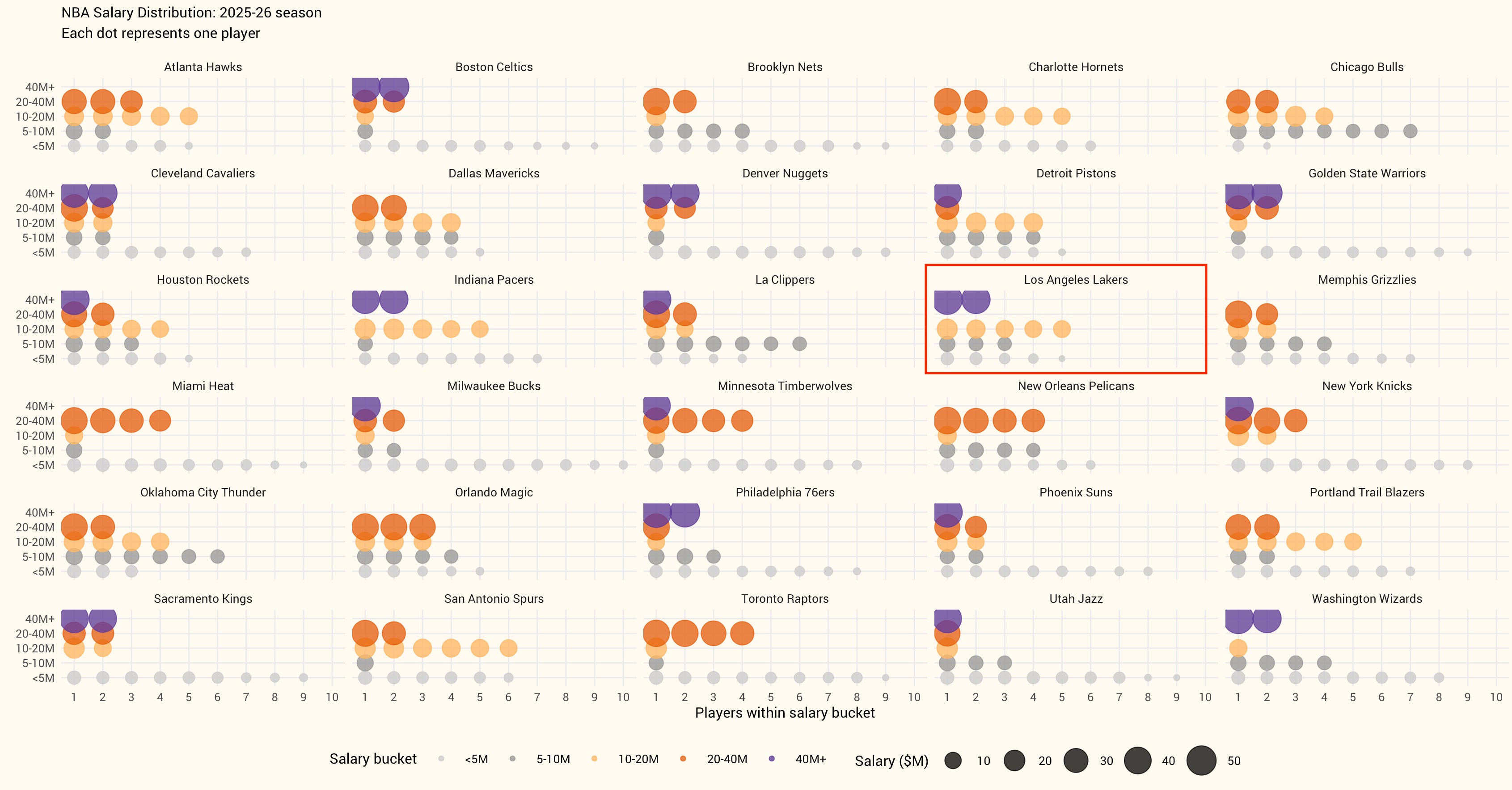
Looking at this chart, you can identify a couple of clear clusters of teams.
