

Lakers Offseason Series: If the LeBron Era Ends This Summer
Building hypothetical Lakers rosters for a post-LeBron future.

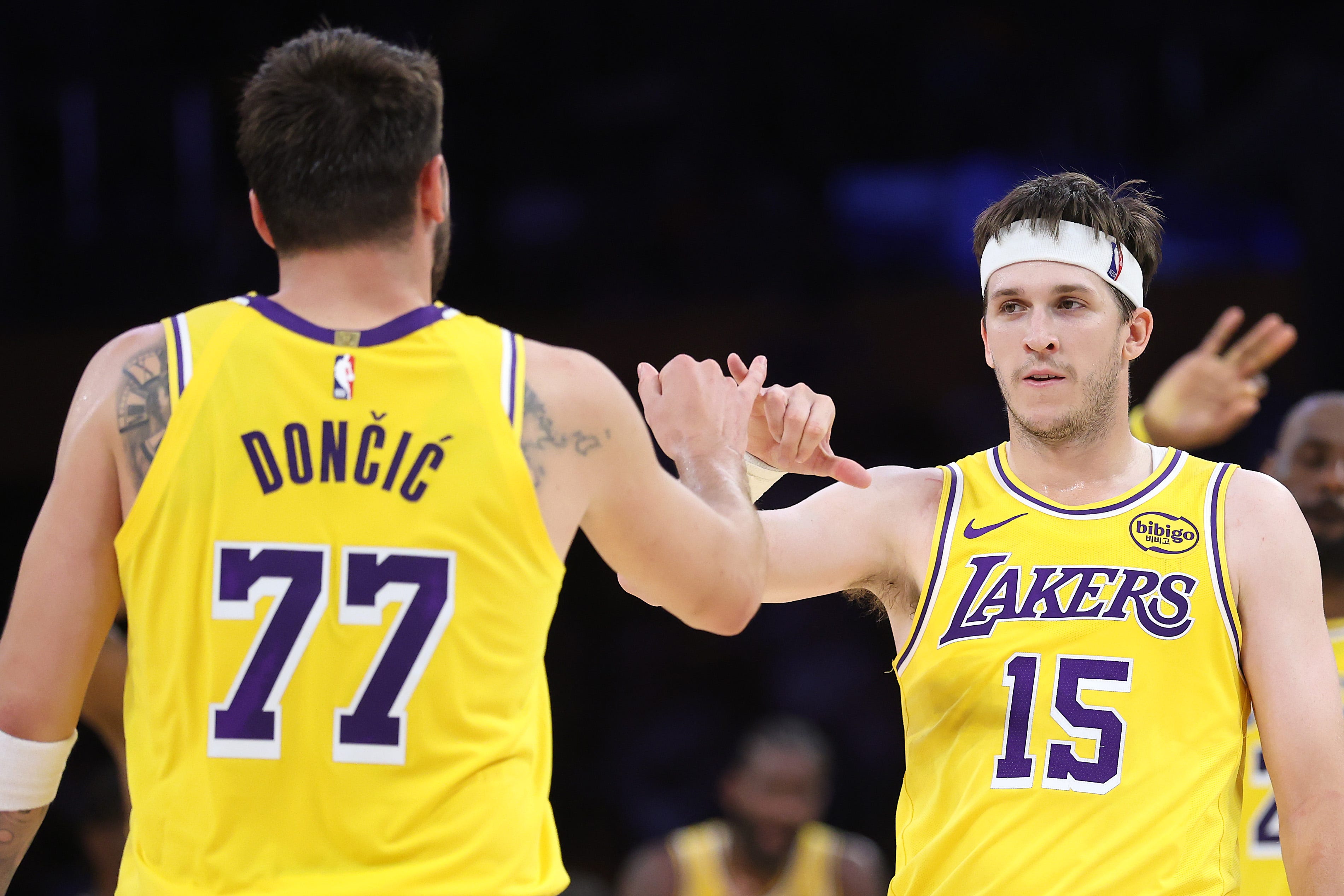
As we continue our breakdown of the Lakers’ crucial offseason, we return to the topic that has quietly become the biggest domino facing the organization this summer: LeBron James.
My last two articles both touched on this question from different angles. In the first, I laid out my view that while the LeBron situation is incredibly complex and involves far more than basketball alone, no true Luka era will begin until the LeBron era ends.
To reiterate, I do not believe a separation between the Lakers and James is the most likely outcome this summer. Nor would I fault the organization if both sides find a way to continue their partnership for another season. James remains an elite player, one of the greatest to ever do it, and his presence impacts everything from the team’s identity, style of play, and roster construction to the business side of the franchise.
Then, in my last column, I looked at how NBA teams are built when it comes to distributing money among players under the new, complex CBA rules. One thing that stood out was the gap the Lakers have in the upper middle class, the $20-40 million AAV range, where high-level starters and elite role players typically reside, especially on mature contenders.
I mentioned that with the optionality Rob Pelinka has patiently built for this summer, the Lakers could have the opportunity to add two starters and fill that gap. That is in the hypothetical scenario where they move on from LeBron, he decides to leave, or, even less likely, he signs for something like the $9.4 million room mid-level exception. If the Lakers bring back LeBron at the number I have seen mentioned by most Lakers media, somewhere in the $25-30 million range, he would effectively occupy one of those spots.
Today, I’m going to explore the options available to the Lakers if they decide to go down the first route and build a team without James for the first time in eight years.
Today’s highlights:
How do you replace LeBron James?
A rare opportunity in Austin Reaves' $20.9 million cap hold
The Lakers’ assets and optionality
A couple of pathways to three complementary starters
1-How do you replace LeBron James?
One of the most frequent arguments I see whenever people even entertain the possibility of a post-LeBron future is simple: How do you replace his production?
James is still producing at an All-Star level, averaging 21 points, 7 rebounds, and 6 assists during the regular season before raising that to 23 points, 7 rebounds, and 7 assists in the playoffs. His impressive postseason performance only strengthens the argument that, even at 41, he is still the best free agent available this summer. The Lakers are simply not going to find a player in this free-agent class who can directly replace that level of production.
Those arguments are certainly legitimate. However, watching the playoffs once again highlighted the counterargument. The best teams are often better than the sum of their parts, with fit, balance, and complementary skill sets mattering just as much as individual talent.
For example, James Harden is one of the other top free agents potentially available this summer and is still a highly impactful player. But is he the best fit next to Donovan Mitchell, a player who shares some of his strengths and weaknesses?
Or take the Knicks as another example. If you swapped Josh Hart, a lesser player in overall talent, for Harden, would that actually make them a better team next to Jalen Brunson? The Knicks’ formula of surrounding Brunson with players who complement their ball-handling star is what brought them to the Finals.
And to be clear, I’m not comparing Harden and James. My point is that James similarly has overlapping strengths and weaknesses with the Lakers’ other two cornerstone players, Dončić and Reaves. James proved at the end of the regular season that he can fill the role of a third option, and even a role player at times. However, the playoffs showed that this is not the role where his talents are best utilized, nor the one he prefers. At 42, expecting James to be a full-throttle, 82-game gap filler for what the Lakers need is neither realistic nor fair.
