

The Lakers Doubled Down on Guard Play and Paint Pressure
Why they signed Collin Sexton, how he fits the new vision, and whether he was the right choice.

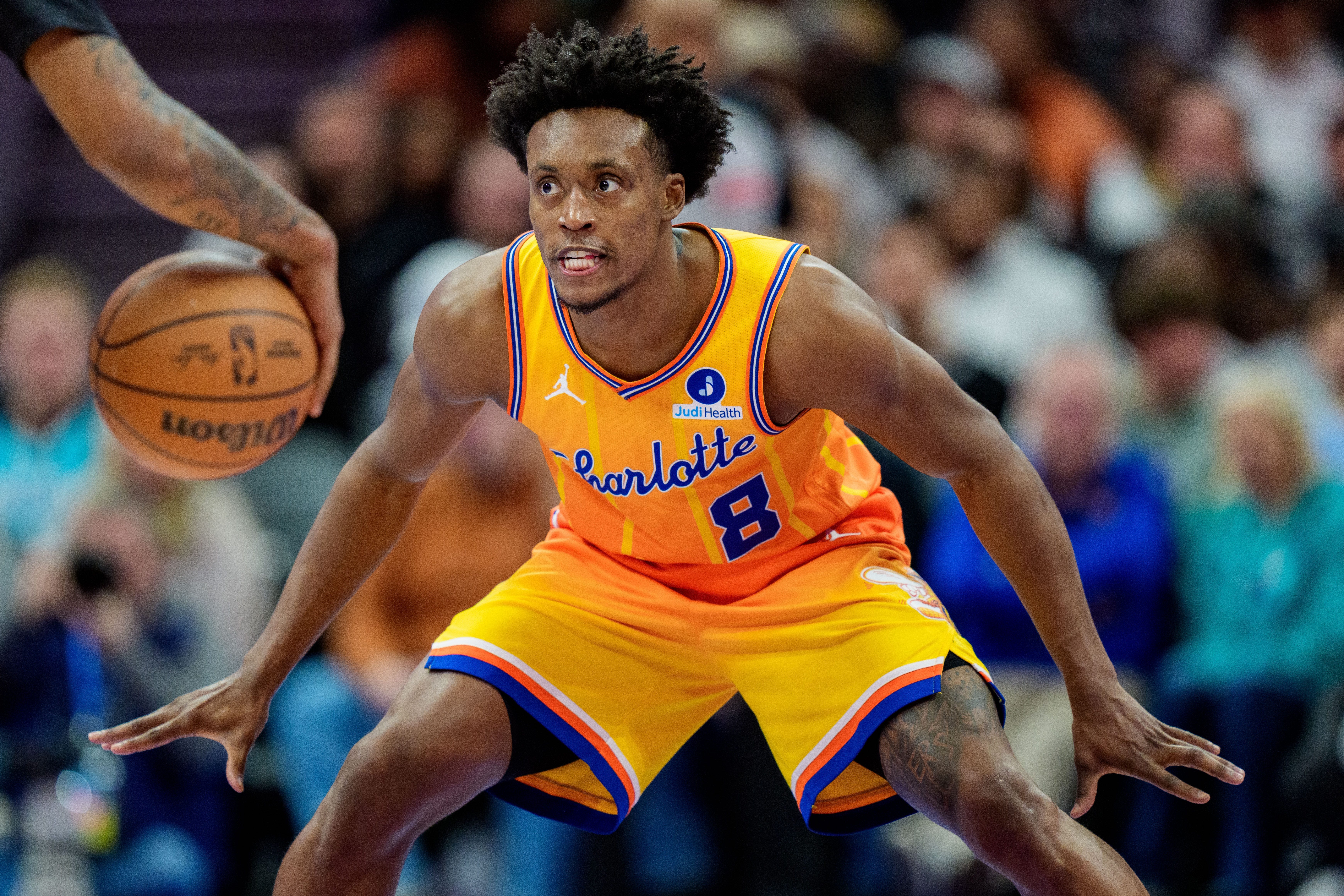
Collin Sexton is the last player in our profile series covering the four signings Rob Pelinka made during that wild 30-minute span on July 1, a stretch that completely reshaped the Lakers and set them on a new course built around Luka Dončić.
We started with Walker Kessler profile, as he is the centerpiece and by far the most important addition of the four. Then we dug into two other key signings, Sandro Mamukelashvili and Quentin Grimes. Today, we finish with Sexton.
Much like Mamu, the Young Bull was a player who had mostly flown under my radar while playing on bad teams in recent years. And I can admit that his signing surprised me.
Now, after spending several days watching his games and digging through the data, with a couple of positive and negative surprises along the way, I can better see the logic behind the addition. That doesn’t mean I agree with it 100 percent, but I’m much more confident that I understand the reasoning behind it.
One last note before we dig in: I’ll keep the same structure I used for the Mamu and Grimes profiles, both for consistency and to wrap up these four key additions in style. I already did quicker deep dives on the Lakers’ other new players as the signings were happening earlier in the offseason, but I might revisit some of the ones who intrigue me most, like Ziaire Williams, in this extended format.
Today’s highlights:
The vision
The skill set
Downhill force
A rare but needed combination of self-creation and spot-up efficiency
Defensive deficiencies
The not-so-surprising investment
The concern
1-The vision
I keep repeating the elements of the vision I’ve tried to decipher from Pelinka’s rebuild in my profiles of the key new additions. And, to be clear, I could be wrong. I could be overthinking or underthinking some of it.
At 27, Sexton is another player who fits the getting younger and Luka timeline criteria. Like Grimes and Mamu, he will bring more of the speed that last year’s team was missing. He is another good and willing three-point shooter, fitting the goal of transforming the Lakers into a high-volume three-point shooting team. Sexton is also super competitive and has a good motor, another encouraging common thread among almost all of the Lakers’ new additions.
However, at 6-foot-3, he also doesn’t fit the description of a lengthy defender one would expect to see filling the gaps around Dončić and Austin Reaves. This is why investing in Sexton, rather than bringing back Marcus Smart, who signed for $3 million less with the Rockets, was one of the more surprising developments of the Lakers’ summer. But it might also be the most telling.
JJ Redick emphasized the ability to dribble, pass, and shoot, and with Sexton, the Lakers added a third ball-handler to provide even more paint pressure alongside the already super-potent 1-2 punch of Dončić and Reaves. Per Genius Sports tracking data, 33 players have recorded more than 2,000 drives over the last three regular seasons. With Dončić, Reaves, and Sexton, the Lakers now feature three players on that list. In terms of drives per 100 possessions, Sexton ranks seventh at 21.5 and Dončić eighth at 21.2, making them two of the NBA’s 10 most persistent drivers.
So, adding Sexton as the third ball-handler and an efficient shotmaker (more on that in the next section), along with Grimes and Mamukelashvili, who also add more driving juice than the players they replaced, is another sign of the Lakers leaning into becoming a super-potent offensive team. Leaning even further into a dynamic, guard-driven offensive identity, with always at least one, but most often two, downhill attackers operating in an environment surrounded by shooting.
2-The skill set
Before diving into Sexton’s strengths and weaknesses, let’s first see how he compares to some of the ball-handlers who have played either alongside Dončić or on recent Lakers teams.
In terms of archetype and usage rate, one could say he most resembles Spencer Dinwiddie and D’Angelo Russell, two point guards who were primary playmakers on bad teams earlier in their careers before evolving into secondary ball-handlers.
In terms of play style, Sexton gets into the paint more than anyone on the list, with Russell Westbrook standing out as the closest comparison in terms of how heavily he relies on drives. Kyrie Irving is the closest comparison in terms of his score-versus-pass profile, while Dennis Schröder is the closest in average touch length and number of dribbles taken.
The data also shows that Sexton is a much more ball-dominant, higher-usage, and more scoring-oriented ball-handler than Marcus Smart and Luke Kennard, the two players who filled the Lakers’ secondary ball-handling roles last season.
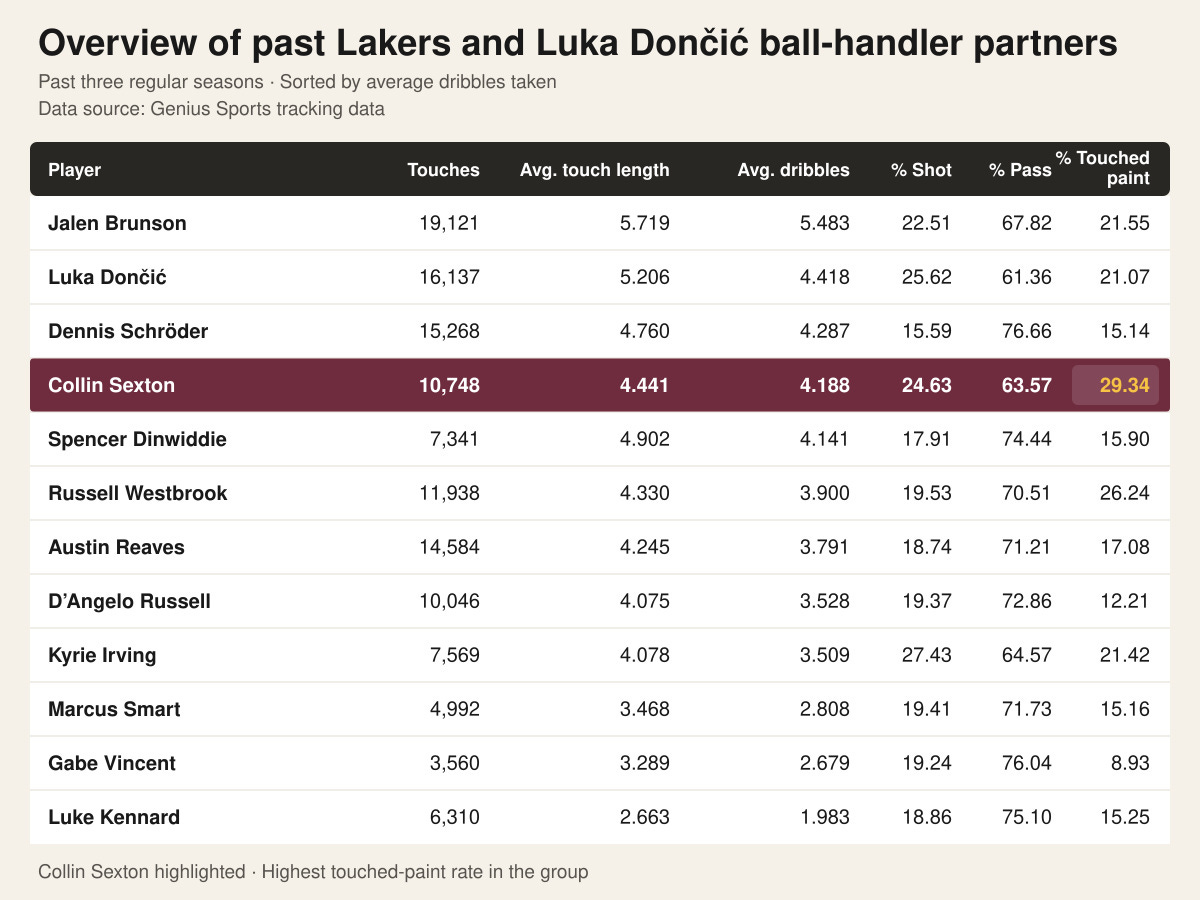
I expect Sexton’s usage rate, touch length, and number of dribbles to come down a bit while playing next to Dončić and Reaves, but not drastically. My main reason for sharing this data is to emphasize again that the Lakers added a third high-usage, scoring-oriented guard to help fill the void left by LeBron James’ departure.
