

Stats With Context: 40-Game Check
The free-fall Lakers need help

Forty games in, nearly half a season under the belt, and it’s time for a 40-game check.
I always try to embed bits of big-picture context and emerging trends into game previews and post-game observations, but these checkpoints are where I step back to track meaningful shifts and evaluate the Lakers’ progress over the course of the season.
If the 10-game check was about perseverance and overcoming early-season injury woes, the 20-game check came at the high point of the season: an 8–2 run, a 15–5 record, and second place in the West — despite advanced numbers suggesting things looked better on the surface than they did under the hood.
Since then, those early warning signs on defense have only been reinforced. A new wave of injuries followed, most notably the calf strain to the team’s second-best scorer and key connector, Austin Reaves, and the Lakers now find themselves in free-fall.
The Lakers are 9–11 since the 20-game check, banged up, and heading into an eight-game road trip. Reinforcements of any kind, whether through health or outside help, feel increasingly necessary.
Today’s highlights:
Quick look at the Western Conference race
Lakers point differential and Four Factors check
Still elite at a lot of things on offense
Defense so bad that even good offense is often not good enough
Injuries, rotation, and reality check
Luka and his three-point shooting trend
Questions and needs heading into the trade deadline
1-Quick look at the Western Conference race
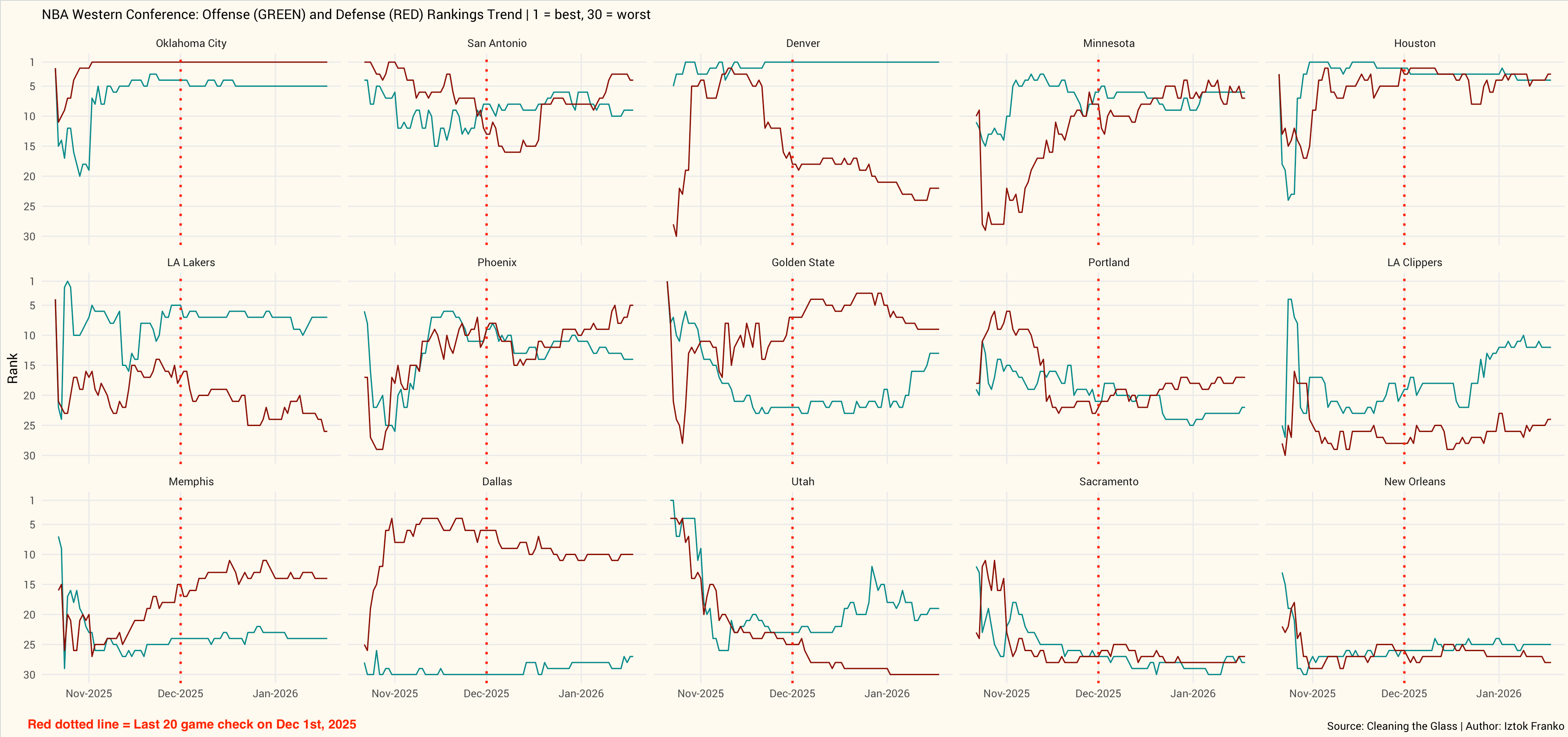
Chart context: As always, we’ll start with a big-picture conference view before zooming in on the Lakers. A couple of quick observations:
The Thunder remain in a league of their own in point differential, though they no longer look quite as unbeatable as they did earlier in the season. The Rockets rank second in point differential and boast a top-five offense and defense, but late-game execution issues have them sitting only sixth in the standings.
Meanwhile, the Timberwolves, Nuggets, and Spurs are bunched tightly together, both in point differential and in the standings, forming a clear and compact top-five group in the West.
Unfortunately for the Lakers, what we’ve seen all season and what was partially masked by their still league-best 13–1 clutch record is that they don’t belong in that top-five group. Even more telling, despite still sitting a few wins ahead of the Suns and the Warriors, both teams have a significantly better point differential.
As the charts show, all of the Lakers’ direct competitors, meaning all of the aforementioned teams except the Nuggets, who have the league’s best offense, rank inside the NBA’s top ten defenses. The defining story of the Lakers over the last 20 games has been the opposite. Their defense has collapsed from roughly league average into bottom-five territory since our last check.
2-Lakers point differential and Four Factors check
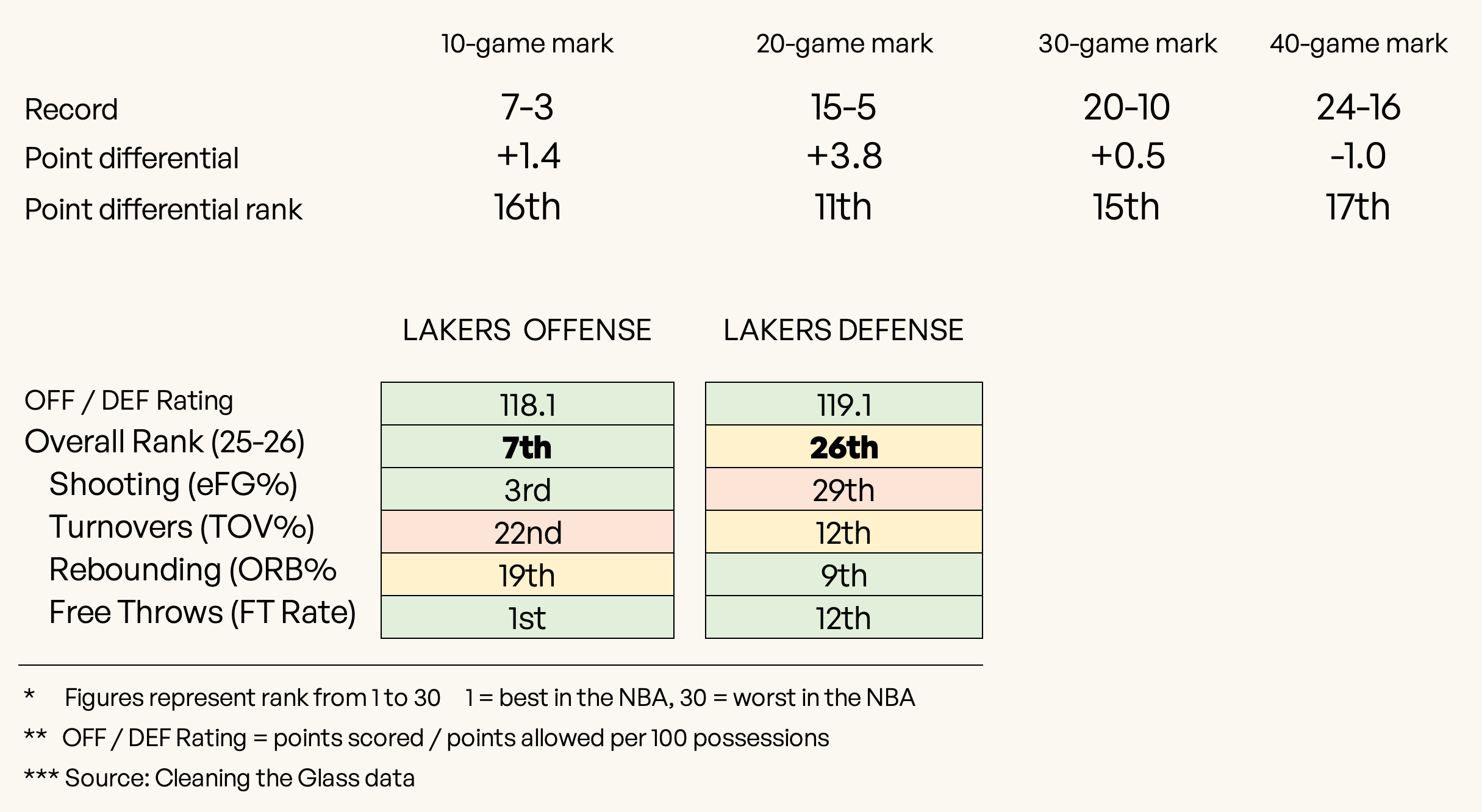
Stats context: I won’t go deep here, as we’ll dissect the offense and defense in the sections that follow. What matters at a high level is this: the Lakers are the only team above .500 with a negative point differential. Teams you would consider true contenders all sit at +5.0 or better, while the Lakers profile much closer to the average .500 team they have been over the last 20 games.
Injuries have clearly played a role. Absences for Austin Reaves, Rui Hachimura, and LeBron James earlier in the season, combined with Luka Dončić missing games in between, have taken a real toll. The Lakers simply have not had a fully healthy group for anything resembling a five or ten game stretch. But since James returned in mid-November, even during relatively healthy stretches or when JJ Redick leaned more heavily on defense-minded lineups, the Lakers’ defense has continued to show signs of structural flaws that will be very hard to overcome with the roster as currently constructed.
